Abstract
This study traces the symbolic lineage of the hexagram across biblical, Second Temple, rabbinic, archaeological, and Renaissance sources, including Amos 5:26, Acts 7:43, 1 Enoch, the Babylonian Talmud (Gittin 68a), Jewish incantation bowls, and early modern occult literature such as Agrippa's Three Books of Occult Philosophy. These materials span different religions, centuries, and geographic contexts, yet repeatedly converge on a shared symbolic nexus: Saturn, the hexagram, demon-binding authority, and malefic spiritual influence.
The study treats sources according to their respective authority: canonical and rabbinic texts as witnesses to ancient belief, archaeological evidence as indicators of material practice, and later occult literature strictly as evidence of post-medieval transmission. It does not claim an unbroken tradition or a single origin, but documents the recurrence of this symbolic logic across traditions that did not coordinate.
Within this evidential framework, a typological pattern emerges. The Hebrew prophets condemn the "star of your god" as Saturnian idolatry (Amos 5:26); Stephen quotes this condemnation at his martyrdom (Acts 7:43); the Talmud preserves Solomon binding the demon-king Ashmedai with a seal bearing God's Name (Gittin 68a); incantation bowls depict hexagrams with chains invoking Solomonic authority; and Christ declares Himself the true "Morning Star" (Revelation 22:16) — the legitimate celestial claimant against all counterfeit astral worship. The paper proposes that this trajectory — from condemned star to binding seal to reclaimed light — represents not coincidence but coherent symbolic logic, culminating in Christ's victory over the powers the hexagram once served.
Methodological Framework
This theory operates across three distinct evidentiary registers, which must be clearly distinguished:
- Historical-Archaeological Evidence: Documented facts about the hexagram's development, including inscriptions, artifacts, and textual sources.
- Scholarly Consensus: Mainstream academic positions on Remphan/Chiun identification, symbol chronology, and Solomonic traditions.
- Theological Interpretation: Christian typological synthesis that connects disparate elements into a redemptive narrative.
Claims from each register are labeled accordingly. The theory's strength lies in convergent evidence across registers, not in any single proof.
A Critical Clarification: Symbolic Continuity, Not Institutional Transmission
This paper argues for conceptual and symbolic continuity—the persistence of associations, motifs, and theological valences across traditions—not an unbroken institutional chain, secret society transmission, or conspiratorial coordination. The "continuity" traced here is analogous to how classical mythology persists in Western art: through cultural memory, textual inheritance, and interpretive reappropriation—not through hidden organizations preserving ancient secrets.
Symbols migrate across cultures through documented mechanisms: trade, conquest, religious syncretism, magical-textual transmission, and artistic borrowing. The hexagram's journey from ancient Near Eastern contexts through Jewish magical practice to modern communal adoption follows these ordinary channels—not extraordinary ones. Readers should evaluate the evidence accordingly.
Relation to Established Scholarship
This theory engages several well-established academic fields without claiming to supersede them:
- Biblical anti-astral polemic: Scholars have long recognized that the Hebrew prophets consistently condemned "host of heaven" worship as incompatible with Yahwism. This paper builds on that consensus.
- Ancient Near Eastern cosmology: The identification of Chiun/Remphan with Saturn derives from comparative Mesopotamian studies—a mainstream position, not a novel claim.
- Divine council and false-god scholarship: The biblical framework of rival spiritual powers (Deuteronomy 32:8–9; Psalm 82; Daniel 10) provides the theological grammar within which this theory operates.
- Symbol history: Scholem's foundational work on the hexagram's development remains authoritative; this paper extends his historical account with theological interpretation, not contradiction.
The originality of this theory lies in synthesis and theological application—connecting established data points into a coherent redemptive-historical narrative—not in overturning scholarly consensus on individual elements.
A Note on Evidentiary Layers — What the Bible Says vs. What the Theory Infers
This theory operates on two distinct evidentiary layers. Critics and readers should evaluate each on its own terms.
Layer 1: The Biblical Framework (Textually Grounded)
The following connections are not constructed by modern interpreters—they are made by the biblical authors themselves, across texts spanning 1,500+ years:
The Star-Molech-Seed Connection
- Amos 5:26 (~760 BC): Condemns "the star of your god" bundled with "the tabernacle of your Moloch"
- Acts 7:43 (~33 AD): Stephen quotes Amos directly, pairing "the star of your god Remphan" with "the tabernacle of Moloch"
- Leviticus 18:21 (~1400 BC): Forbids giving "seed" to Molech—the same deity bundled with the star
- Genesis 3:15 (Primordial): The serpent's seed vs. the woman's seed; her seed will crush his head
- Galatians 3:16 (~50 AD): Paul explicitly identifies "the seed" as Christ
The Molech system targeted "seed" (offspring). Paul identifies "seed" as Christ. The star is bundled with Molech. This is not modern pattern-matching—it is Paul reading his Bible.
The Fallen Star / Morning Star Pattern
- Isaiah 14:12–15 (~700 BC): "Lucifer, son of the morning" falls from heaven, aspiring above God's stars
- 2 Corinthians 11:14 (~55 AD): Paul says Satan disguises himself as "an angel of light"
- Amos 5:7 (~760 BC): "Wormwood" invoked as symbol of corruption—two verses before the star condemnation
- Revelation 8:10–11 (~95 AD): A star named "Wormwood" falls from heaven, poisons waters, brings death
- Revelation 9:11 (~95 AD): Abaddon/Apollyon ("Destroyer") rules the abyss
- Revelation 22:16 (~95 AD): Christ declares: "I am the root and the offspring of David, and the bright and morning star"
False stars bring death (Isaiah, Amos, Revelation 8–9). Christ reclaims the title (Revelation 22). This pattern is in the text—John is deliberately using Isaiah's language.
The Chain and Seal
- Revelation 20:1–3 (~95 AD): An angel binds Satan with "a great chain" and sets "a seal upon him"
- Colossians 2:15 (~60 AD): Christ "disarmed principalities and powers, triumphing over them"
The imagery of demonic binding with chains and seals appears in Scripture itself—predating or paralleling the Solomonic magical traditions.
The Convergence Point: Revelation 22:16
In a single verse, Christ claims:
- Davidic lineage: "Root and offspring of David" — connecting to Solomon, the seal-bearer
- Morning star title: Reclaiming what Isaiah 14's fallen figure forfeited
- Context: Same book that describes Satan bound with chain and seal (Revelation 20)
One verse. Three threads. All converging on the same point the theory makes—and none of it requires external inference.
Layer 2: Symbol Transmission (Inferential)
The second layer of the theory—tracing the hexagram's journey from ancient condemnation to modern symbol—requires historical inference:
- The "star of Remphan" is not described geometrically in Scripture
- No ancient text explicitly says "Remphan's star was a hexagram"
- The incantation bowl shows early hexagramic sealing but doesn't mention Remphan or Saturn
- The connection between Chiun/Remphan (Saturn) and the hexagram (later "talisman of Saturn") is inferred from parallel associations, not direct documentation
This layer is speculative synthesis. It connects documented points (Remphan = Saturn, hexagram = Saturn's talisman, hexagram = Seal of Solomon) into a transmission chain that no single source attests.
The theory acknowledges this. Readers may accept or reject the symbol transmission argument while still engaging the biblical framework on its own terms.
Note: Renaissance primary sources provide visual confirmation of the hexagram-Saturn association. Agrippa's Three Books of Occult Philosophy (1533) depicts the lunar dragon surrounded by hexagram stars, with the Dragon's Tail + Saturn explicitly producing an "evill Genius." While this does not prove ancient usage, it demonstrates established symbolic continuity by the 16th century.
Why This Distinction Matters
Critics have attacked this theory as "pattern-matching" and "conspiracy reasoning." That critique has force against Layer 2—the symbol transmission chain is indeed inferential.
But the critique fails entirely against Layer 1. The biblical authors themselves make these connections:
- Stephen quotes Amos
- Paul interprets Genesis
- John echoes Isaiah
- Revelation uses the same "wormwood" from Amos's context
Dismissing this as "modern pattern-matching" requires ignoring that the pattern is in the text, not projected onto it. The Bible presents a coherent narrative: a condemned star system tied to child sacrifice and false light, ultimately defeated by the true Morning Star—David's greater Son.
Layer 1 stands even if Layer 2 is contested. The reader is invited to evaluate each on its own merits.
Part I: The Historical Foundation
1. The Hexagram's Davidic Connection: Through Solomon, Not David Himself
Evidentiary Status: Historical consensus.
There is no biblical or archaeological evidence that King David himself used a star symbol. The "shield" (magen) of David in Scripture is poetic—referring to God as protector (Psalm 18:2, 35). However, the hexagram does have legitimate Davidic lineage through Solomon, David's son, who received divine sealing authority over demons. The name "Magen David" is a late communal adoption (17th–19th century), but the underlying connection to David's line—through Solomon—is ancient.
[Citation: Gershom Scholem, "The Star of David: History of a Symbol," in The Messianic Idea in Judaism (1971), pp. 257–281]
Prior to its association with Solomonic sealing traditions, the hexagram appears sporadically in antiquity as geometric decoration without specific Jewish meaning: examples include the 3rd–4th century Capernaum synagogue, where hexagrams appear alongside pentagrams, swastikas, and other ornamental motifs.
The hexagram gains mystical and protective meaning in medieval Kabbalah as the "Seal of Solomon," becomes a widespread Jewish communal emblem in the 17th–19th centuries (notably the Prague Jewish community flag), and achieves national status through Zionism (1897 Congress) and Israel's flag (1948).
[Citation: Jewish Encyclopedia (1906), s.v. "Magen David"; Scholem (1971)]
2. Scripture Condemns a "Star" Idol Linked to Saturn
Evidentiary Status: Biblical text + scholarly consensus.
The Hebrew Bible and New Testament explicitly condemn astral idolatry involving a "star" deity:
"Then God turned, and gave them up to worship the host of heaven; as it is written in the book of the prophets, O ye house of Israel, have ye offered to me slain beasts and sacrifices by the space of forty years in the wilderness? Yea, ye took up the tabernacle of Moloch, and the star of your god Remphan, figures which ye made to worship them: and I will carry you away beyond Babylon." — Acts 7:42–43 (KJV)
"But ye have borne the tabernacle of your Moloch and Chiun your images, the star of your god, which ye made to yourselves. Therefore will I cause you to go into captivity beyond Damascus, saith the LORD, whose name is The God of hosts." — Amos 5:26–27 (KJV)
Scholars identify Remphan (LXX: Ῥαιφάν) and Chiun/Kiyyun (Hebrew: כִּיּוּן) as variant names for the Mesopotamian astral deity associated with the planet Saturn. This represents syncretistic worship—mixing Yahweh worship with planetary gods (the "host of heaven" condemned throughout the prophets).
[Citation: Ernst Würthwein, The Text of the Old Testament (1979); James A. Montgomery, A Critical and Exegetical Commentary on the Book of Daniel (1927), on Mesopotamian astral religion]
[Citation: Anchor Bible Dictionary (1992), s.v. "Kaiwan"; TDOT, s.v. "כִּיּוּן"]
Babylonian Origins: The Linguistic and Historical Evidence
The identification of Chiun/Remphan with Saturn is not modern conjecture — it is firmly rooted in Mesopotamian astronomy and documented linguistic transmission.
The earliest comprehensive Babylonian astronomical compendium, MUL.APIN (compiled ~1000 BCE, with copies surviving from the 8th–7th centuries BCE), explicitly names Saturn as Kajamānu (Akkadian: 𒅗𒀀𒀀𒈠𒉡), meaning "The Constant" or "The Steady One." This designation passes through documented linguistic stages:
- Akkadian: Kajamānu (MUL.APIN, ~1000 BCE)
- Aramaic/Syriac: Kewan
- Hebrew: כִּיּוּן — Kiyyun/Chiun (Amos 5:26, ~750 BCE)
- Greek (Septuagint): Ῥαιφάν — Raiphan/Remphan (3rd century BCE)
- New Testament: Remphan (Acts 7:43, ~33 CE)
The Encyclopaedia Judaica confirms this chain, noting that "Chiun is identified with the Akkadian Kajamānu... 'the steady one,' the appellation of the star god Saturn (hence Aramaic Kewan, Arabic Kaiwan)." The phonetic shift from m to w is a documented feature of Akkadian intervocalic pronunciation.
Strikingly, Babylonian expiatory prayers known as Šurpu pair "Sikkuth and Kajamānu" together in ritual invocations — the same pairing that appears in Amos 5:26: "the tabernacle of your Moloch [Sikkuth] and Chiun [Kajamānu] your images." The prophet condemns not an indigenous Israelite practice, but imported Babylonian astral religion.
This Babylonian attestation predates Amos (~750 BCE) by approximately 250 years. The cult was foreign. The poetic justice of Israel's punishment is striking: having adopted Babylon's gods, they were exiled to Babylon (Acts 7:43).
[Citation: Hermann Hunger & David Pingree, MUL.APIN: An Astronomical Compendium in Cuneiform (1989); Hunger & John Steele, The Babylonian Astronomical Compendium MUL.APIN (Routledge, 2018); Encyclopaedia Judaica, s.v. "Sikkuth and Chiun"]
The Hexagram in Assyrian Astral Religion: The Morning Star Connection
Evidentiary Status: Archaeological artifact + institutional documentation.
A critical piece of evidence places the hexagram within the very religious system that produced Chiun/Kajamānu — and explicitly connects it to the "morning star" title that Scripture assigns to both the fallen rebel of Isaiah 14 and the triumphant Christ of Revelation 22.
The Kurkh Stela (British Museum, ~852 BCE)
The Kurkh Stela of Shalmaneser III, now in the British Museum (Museum no. 118884), depicts the Assyrian king standing in worship before four divine emblems. The British Museum's catalog explicitly identifies these as:
"(1) the winged disk, the symbol of the god Ashur, or, as some hold, of Shamash; (2) the six-pointed star of Ishtar, goddess of the morning and evening star; (3) the crown of the sky-god Anu, in this instance with three horns, in profile; (4) the disk and crescent of the god Sin as the new and the full moon." — British Museum Collection Online
Notably, the same artifact depicts an eight-pointed star on the king's collar, identified as "probably the symbol of Shamash, the sun-god." Both six-pointed and eight-pointed stars functioned as divine astral emblems in Assyrian religion, with distinct attributions. The hexagram belonged to Ishtar — the morning star.
While Ishtar is more commonly associated with an eight-pointed star in other Mesopotamian artifacts, the British Museum explicitly identifies this six-pointed star on the Kurkh Stela as her emblem. The variation does not diminish the identification; it demonstrates that both forms operated within the same symbolic vocabulary of Assyrian astral religion.
This is not a decorative motif. The Kurkh Stela is fundamentally a religious artifact. Shalmaneser III stands in an attitude of prayer, his right hand raised toward these divine symbols. The emblems explicitly invoke divine protection and legitimize the king's rule as divinely sanctioned. The hexagram appears here as an object of royal worship.
The Morning Star Identification
The British Museum's description is precise: Ishtar is "goddess of the morning and evening star" — that is, the planet Venus, which appears as the brightest object in the sky at dawn and dusk. This identification carries profound biblical resonance:
| Text | Figure | Title |
|---|---|---|
| Kurkh Stela (~852 BCE) | Ishtar | "Morning and evening star" |
| Isaiah 14:12 | Helel/Lucifer | "Son of the morning" (בֶּן־שָׁחַר) |
| Revelation 22:16 | Christ | "The bright and morning star" |
The hexagram is not merely associated with astral worship in general. It is archaeologically attested as the specific symbol of the deity claiming the "morning star" title — the same title Isaiah assigns to the fallen rebel and Christ reclaims in Revelation. The symbolic contest over that title now has a documented visual emblem.
The Ishtar-Astarte Connection
Ishtar's Canaanite equivalent was Astarte (Ashtoreth), consort of Baal and the "Queen of Heaven" whom Jeremiah condemns (Jeremiah 44:17–19; cf. 1 Kings 11:5, where Solomon falls to her worship). The unified Baal-Molech-Saturn system documented in Section 3 included Astarte worship. If the hexagram functioned as Ishtar's emblem in Mesopotamia, it likely transmitted westward with her cult — as other Mesopotamian religious elements demonstrably did (see "The Babylonian-Canaanite Transmission" below).
The Significance for This Study
Temporal proximity. The Kurkh Stela dates to approximately 852 BCE — roughly one century before Amos's prophecy (~750 BCE). This is not distant Sumerian prehistory but contemporary Assyrian imperial religion, within living cultural memory of the prophetic condemnation.
Cultural continuity. Shalmaneser III is the same Assyrian king depicted on the Black Obelisk receiving tribute from Jehu of Israel (841 BCE). Israel was not isolated from Assyrian religious influence; the northern kingdom was politically subjugated to and culturally entangled with the very empire whose monuments bear this hexagram. The MUL.APIN tablets that name Saturn as Kajamānu emerge from this same Assyrian scholarly tradition — the same imperial context, the same astral-theological framework, the same century.
The morning star contest. Isaiah 14 depicts a figure who aspired to ascend above "the stars of God" and is cast down to Sheol, where the Rephaim greet him (see Section 13). This fallen "son of the morning" is a counterfeit — and the symbol of the original "morning star" deity (Ishtar) was the hexagram. Christ's declaration "I am the bright and morning star" (Revelation 22:16) reclaims the title; the seal on Satan's prison (Revelation 20:1–3) may employ the usurper's own symbol against him.
What This Does Not Prove
The Kurkh Stela does not prove that the "star of your god" in Amos 5:26 was specifically a hexagram. No ancient source makes that identification explicit. However, the evidence demonstrates that:
- The hexagram functioned as a divine astral symbol in 9th-century BCE Assyrian religion
- It specifically represented Ishtar, the "morning and evening star"
- This religious system is the same one that produced Chiun/Kajamānu (Saturn) and dominated Israel politically during the prophetic period
The inferential chain shortens considerably. The argument no longer requires projecting medieval Saturn-hexagram associations backward across two millennia. The hexagram is attested in Assyrian astral religion one century before Amos — in the same cultural matrix, serving the same class of astral deities, under the same empire whose gods Israel adopted, explicitly representing the "morning star" title that Scripture treats as contested territory.
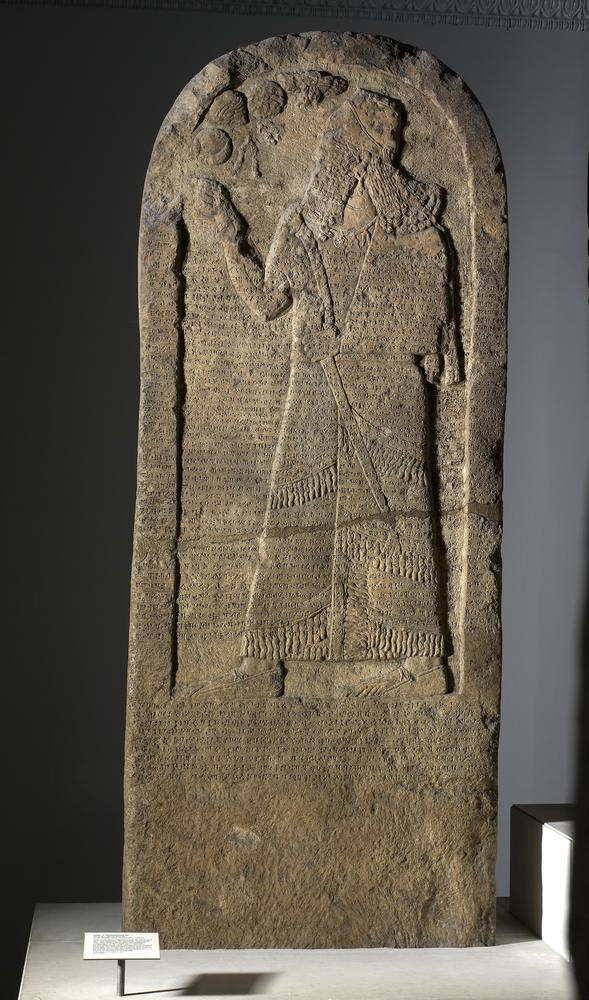
[Citation: British Museum Collection Online, "The Kurkh Stela," Museum no. 118884 (Neo-Assyrian, c. 852 BCE); Luckenbill, Ancient Records of Assyria and Babylonia, vol. I, pp. 211–13; Pritchard, The Ancient Near East in Pictures Relating to the Old Testament, fig. 443]
The Babylonian-Canaanite Transmission
How did Babylonian astral religion reach Israel? Through Canaan.
Canaan was a province of the Babylonian Empire during the Dynasty of Ur (~2500 BCE), and Babylonian cultural influence remained profound for centuries. Scholars note that "Canaanitish culture became largely Babylonian in character, with Babylonian religious beliefs and deities replacing or superimposing earlier Canaanite ones." Babylonian deities migrated westward: Ishtar became Ashtoreth; Asirtu became Asherah. Hammurabi's legal code was enforced in Canaan, and cuneiform script was taught in Canaanite schools.
This cultural transmission explains a critical connection: the Phoenician/Carthaginian deity Baal Hammon was identified by Greek and Roman writers with Kronos/Saturn — the child-devouring god. Archaeological evidence from Carthaginian Tophet sites includes urns containing cremated infant remains, and Diodorus Siculus (1st century BCE) describes bronze statues of Kronos with outstretched arms where children were burned as offerings.
The chain is now complete:
| Stage | Location | Evidence |
|---|---|---|
| Origin | Babylon | MUL.APIN: Saturn = Kajamānu (~1000 BCE) |
| Transmission | Canaan | Babylonian deities migrate; Baal Hammon = Saturn = child-devourer |
| Adoption | Israel | Amos 5:26: Moloch + Chiun (Saturn) + star condemned |
| Judgment | Babylon | Israel exiled TO Babylon (Acts 7:43) — poetic justice |
Amos's condemnation of "the tabernacle of your Moloch and Chiun your images, the star of your god" now has full historical context. Israel adopted Babylonian astral religion through Canaanite cultural mediation. The child-sacrifice deity (Moloch/Baal Hammon) and the Saturn star-god (Chiun/Kajamānu) were bundled together — as they had been in Mesopotamian religion for centuries.
The cult was foreign. The judgment was fitting.
[Citation: Diodorus Siculus, Bibliotheca Historica, 20.14; archaeological reports on Carthaginian Tophet sites]
Critically, both texts explicitly pair the star deity with Moloch worship—a connection with profound implications explored in Part II.
For visual evidence of Saturn as child-devourer bearing the hexagram marked with his planetary glyph, see the discussion of the Weiditz woodcut (British Museum, 1515–1536) in Section 4.
3. The Many Names of One System
Evidentiary Status: Biblical text + classical sources + archaeological confirmation.
What appears to be a bewildering array of deities across ancient cultures — Baal, Molech, Saturn, Kronos, Chiun, Remphan, El, Baal Hammon — is not a pantheon of separate gods. The biblical and classical sources reveal that these are names, titles, and cultural translations for one unified religious system that demanded child sacrifice and used the star as its symbol.
The Linguistic Evidence: Titles, Not Names
"Baal" is not a personal name — it is a title:
- Hebrew: בַּעַל (ba'al) = "Lord," "Master," "Owner"
- Applied to various local manifestations: Baal-Peor, Baal-Zebub, Baal Hammon, etc.
- The title could apply to any deity worshipped as "Lord"
"Molech" is likewise not a personal name — it is a pejorative title:
- Derives from מֶלֶךְ (melech) = "king"
- Vowels replaced with those from בֹּשֶׁת (boshet) = "shame"
- Thus "Molech" = "shameful king" — a deliberate Israelite insult
The Encyclopaedia Britannica confirms: "The name derives from combining the consonants of the Hebrew melech ('king') with the vowels of boshet ('shame'), the latter often being used in the Old Testament as a variant name for the popular god Baal."
The Biblical Proof: Jeremiah 32:35
One verse demolishes any notion that Baal and Molech are separate deities:
"And they built the high places of Baal, which are in the valley of the son of Hinnom, to cause their sons and their daughters to pass through the fire unto Molech; which I commanded them not, neither came it into my mind, that they should do this abomination, to cause Judah to sin." — Jeremiah 32:35 (KJV)
Both names appear in the same verse, describing the same practice, at the same location — the Valley of Ben-Hinnom (Gehenna). The "high places of Baal" are where children "pass through the fire unto Molech." These are not two cults operating at the same site; they are two titles for one system.
Jeremiah 19:5 confirms that Baal himself received child sacrifice:
"They have built also the high places of Baal, to burn their sons with fire for burnt offerings unto Baal, which I commanded not, nor spake it, neither came it into my mind." — Jeremiah 19:5 (KJV)
Baal receives child sacrifice. Molech receives child sacrifice. Both are worshipped at the same high places in the Valley of Hinnom. The conclusion is unavoidable: these titles designate one religious system.
The Complete Name Table
| Name | Language | Meaning | Region |
|---|---|---|---|
| Baal | Canaanite | "Lord" (title) | Canaan/Israel |
| Molech/Moloch | Hebrew | "Shameful King" (pejorative) | Canaan/Israel/Ammon |
| Baal Hammon | Phoenician/Punic | "Lord of the Brazier" | Carthage/Phoenicia |
| El | Canaanite | "God" — head of pantheon | Canaan |
| Kronos | Greek | Titan who devoured children | Greece |
| Saturn | Latin | Roman equivalent of Kronos | Rome |
| Chiun (כִּיּוּן) | Hebrew | Star-god = Saturn | Israel |
| Remphan (Ῥαιφάν) | Greek | Star-god = Saturn | Hellenistic |
One system. One demand (children). One symbol (the star). One enemy (the Seed).
The Classical Confirmation
Greek and Roman writers independently identified these "deities" as one:
- Diodorus Siculus (1st century BCE): Explicitly identifies Carthaginian Baal Hammon with Greek Kronos. Describes the bronze statue with outstretched arms receiving children: "There was in their city a bronze image of Cronus extending its hands, palms up and sloping toward the ground, so that each of the children when placed thereon rolled down and fell into a sort of gaping pit filled with fire." (Library of History, Book 20.14)
- Philo of Byblos (1st–2nd century CE): Preserving older Phoenician sources, identifies Phoenician El with Greek Kronos. El/Kronos sacrificed his own son. (Preserved in Eusebius, Praeparatio Evangelica)
- Kleitarchos (3rd century BCE): Describes the Carthaginian practice: children placed on the bronze statue's sloping arms, rolling into the fire pit below.
- Plutarch: Records that El was called "Malkandros" = "King of Man" (מלך אדם), connecting the Canaanite El to the "king" (melech) terminology. (De Iside et Osiride)
The Greeks and Romans were not confused. They recognized that these various Semitic deities were manifestations of the same entity they knew as Kronos/Saturn — the child-devourer.*
* Classical sources independently attest this mythic complex. Hyginus (Fabulae, 1st c. BCE) lists Saturnus among the Titans, documents the Gigantes as born "ex terra & tartaro," and includes Typhon among the giants, demonstrating that the Saturn–giant–dragon complex was recognized across the ancient Mediterranean world and not constructed by later interpreters.
The Archaeological Confirmation: Carthage
The Carthaginian Tophet provides the most extensive archaeological evidence for this unified system:
| Data Point | Source |
|---|---|
| 20,000+ urns containing child remains | Stager & Wolff (Harvard), 1984 |
| 6,000+ stelae (dedicatory grave markers) | Archaeological record |
| Site size: 6,000 square meters, 9 levels | Archaeological record |
| Date range: ~800 BCE – 146 BCE | Archaeological record |
| Inscriptions dedicated to Baal Hammon and Tanit | Epigraphic evidence |
| Term "mlk" appears on artifacts | Same root as biblical "Molech" |
| Age distribution: under 3 months over-represented | Patricia Smith (Hebrew U/Harvard) |
| Estimated rate: ~25 sacrifices/year | 2014 Oxford study |
A 2014 Oxford study led by Dr. Josephine Quinn concluded: "When you pull together all the evidence — archaeological, epigraphic and literary — it is overwhelming and, we believe, conclusive: they did kill their children, and on the evidence of the inscriptions, not just as an offering for future favours but fulfilling a vow."
The Saturn Temple: Roman Confirmation
After Rome destroyed Carthage in 146 BCE, the Romans later built a temple to Saturn on the exact site of the Tophet. This was not coincidence — it was recognition. The Romans understood that Baal Hammon was their Saturn. The identification was not modern scholarly reconstruction; it was ancient Roman understanding.
The Transmission Chain
The unified system traced through documented history:
- Babylon (~1000 BCE): MUL.APIN tablets name Saturn as Kajamānu ("the steady one")
- Canaan: El/Baal system adopted; El identified with Kronos (per Philo of Byblos); child sacrifice practiced
- Phoenicia → Carthage: Baal Hammon + Tanit worship established; Tophets built — 20,000+ child sacrifices documented at Carthage alone
- Israel (apostate periods): "High places of Baal... to pass through fire unto Molech" (Jer 32:35); "Tabernacle of Moloch and Chiun... the star of your god" (Amos 5:26); site: Valley of Ben-Hinnom (Topheth) outside Jerusalem
- Prophetic condemnation: Jeremiah condemns (7:31, 19:5-6, 32:35); Josiah defiles the Topheth (2 Kings 23:10)
- Stephen's indictment (Acts 7:43): "The star of your god Remphan" — same system, Greek name
- Roman Carthage: Temple to Saturn built on Tophet site — the identification complete
Amos 5:26 in Context
With this unified system established, Amos 5:26 becomes fully comprehensible:
"But ye have borne the tabernacle of your Moloch and Chiun your images, the star of your god, which ye made to yourselves." — Amos 5:26 (KJV)
This is not three separate condemnations. It is one:
- Moloch: The "shameful king" — the pejorative Hebrew title for the child-sacrifice cult
- Chiun: The star-god — Hebrew rendering of Akkadian Kajamānu (Saturn)
- The star: The astral symbol of this unified system
When Stephen quotes this passage in Acts 7:43, he uses "Remphan" — the Greek form of the Saturn identification. The prophetic condemnation spans languages, cultures, and centuries, but targets one system.
Conclusion: The Enemy Identified
The apparent multiplicity of names across ancient cultures does not indicate separate deities; it reflects one demonic system adapting to local languages and cultural contexts while maintaining its core demands:
- Child sacrifice (the attack on the Seed)
- Astral worship (the counterfeit star)
- The "king" who demands what belongs to God (children, worship, authority)
This is the system Solomon fell to (1 Kings 11:7). This is the system the prophets condemned. This is the system whose star Stephen denounced at his martyrdom. And this is the system whose chief — "that old serpent, which is the Devil, and Satan" — is ultimately bound with chain and seal (Revelation 20:1-3).
For the "seed" terminology and its messianic significance, see Section 9. For Solomon's fall to this system, see Section 7. For the site where this unified system operated in Israel — the Valley of Ben-Hinnom, transformed from altar to prison — see Section 11. For the astral dimension of this worship — the counterfeit morning star of Isaiah 14 — see Section 13.
[Citation: Diodorus Siculus, Library of History, Book 20.14; Philo of Byblos via Eusebius, Praeparatio Evangelica; Lawrence Stager & Samuel Wolff, "Child Sacrifice at Carthage," Biblical Archaeology Review (1984); Dr. Josephine Quinn et al., "Carthaginian Infant Sacrifice," Antiquity 88 (2014); John Day, Yahweh and the Gods of Canaan (Cambridge, 2002); George Heider, The Cult of Molek: A Reassessment (1985)]
4. Solomonic Demon-Binding Traditions
Evidentiary Status: Historical sources (non-canonical but genuine).
Traditions attributing demon-binding power to Solomon appear in multiple ancient sources:
- Josephus (1st century CE): Antiquities 8.2.5 describes Solomon composing incantations and exorcisms, with Eleazar using a Solomonic ring to expel demons before Vespasian.
- Testament of Solomon (1st–5th centuries CE): A pseudepigraphical text depicting Solomon receiving a divine ring/seal to conscript demons for Temple construction, using their own names and seals against them.
- Medieval Grimoires (14th–17th centuries): The Key of Solomon and related texts standardize the hexagram as the "Seal of Solomon" for spirit-binding, often explicitly called a "talisman of Saturn."
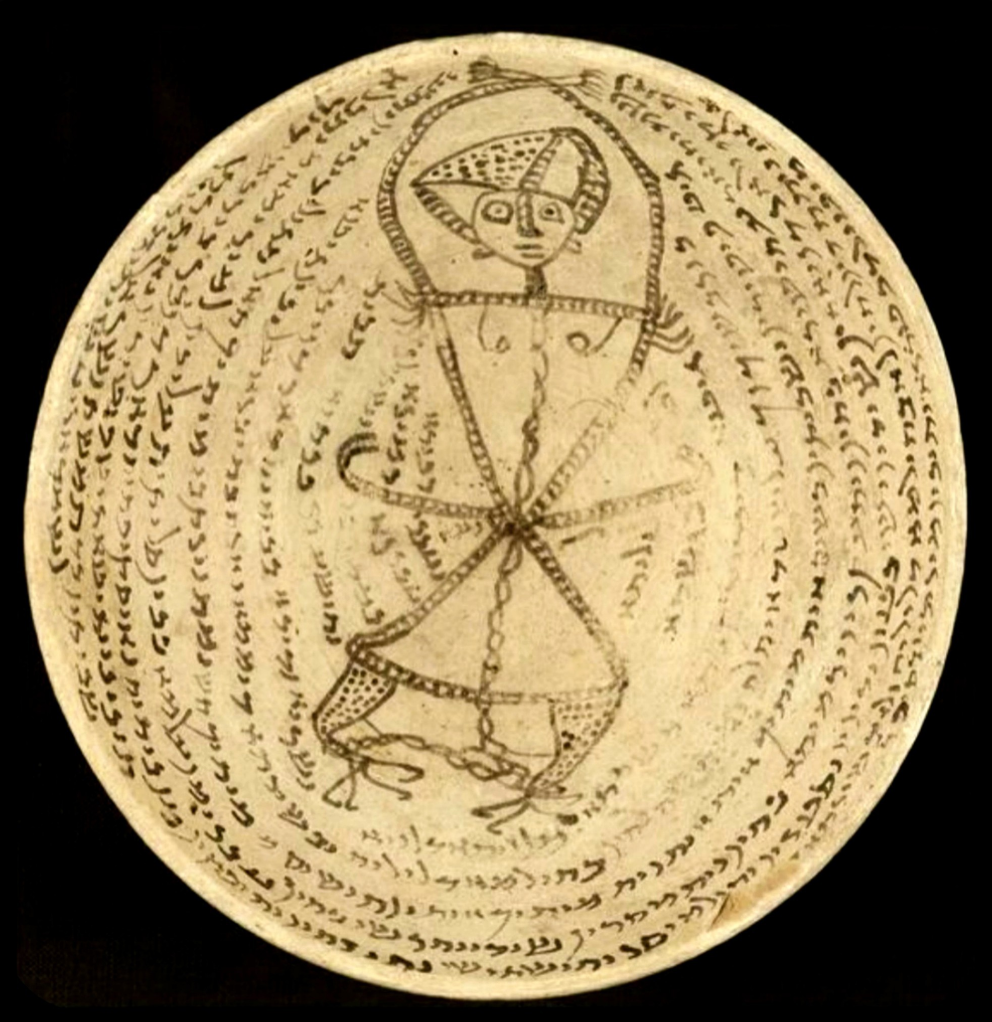
- Babylonian Talmud, Gittin 68a (5th century CE): The Talmud records Solomon sending Benayahu (בְּנָיָהוּ, meaning "Son of Yah/God") to capture Ashmedai, king of the demons. Solomon provides "a chain onto which a sacred name of God was carved, and a ring onto which a sacred name of God was carved." When bound, Benayahu declares: "The name of your Master is upon you!" This establishes that Solomonic demon-binding operates through divine Name authority, chains, and signet rings — and that the binder is explicitly named "Son of God." The typological significance is explored in Section 19.
[Citation: Josephus, Antiquities of the Jews, 8.2.5; D.C. Duling, trans., "Testament of Solomon" in OTP vol. 1 (1983); Joseph Peterson, ed., The Key of Solomon (2001)]
[Citation: Babylonian Talmud, Tractate Gittin 68a-68b, Soncino/Artscroll editions; cf. Sefaria.org for original Aramaic text]
These traditions establish that (a) Solomon was credited with sealing authority over demons, and (b) this authority became associated with star-shaped sigils, particularly the hexagram, by the medieval period.
Renaissance Continuity: Agrippa's Saturn-Dragon-Hexagram Nexus
Note on Symbolic Distinction: The hexagram's function in Renaissance planetary magic should not be conflated with its later adoption as a Jewish religious and ethnic symbol (Magen David). The same geometric form operated differently across cultural systems — as a planetary talisman in Hermetic magic, and as a communal identifier in Jewish tradition. This study traces the esoteric transmission; it makes no claims about the religious symbol's meaning or legitimacy.
Evidentiary Status: Visual and textual primary source from Renaissance planetary magic. Layer 2 (inferential transmission).
Note on Source Authority: Unlike the biblical and rabbinic sources discussed elsewhere in this study, Agrippa's Three Books of Occult Philosophy carries no religious or doctrinal authority. It is cited here strictly as historical evidence of Renaissance magical belief and practice, not as proof of ancient Israelite or Second Temple tradition.
The German polymath Heinrich Cornelius Agrippa von Nettesheim (1486–1535) produced the most systematic encyclopedia of Renaissance magic: Three Books of Occult Philosophy (De Occulta Philosophia), first published in 1533. This work synthesized Arabic, Jewish, and Hermetic magical traditions into a coherent system. Within it, we find striking visual and textual evidence linking Saturn, the dragon/serpent, and the hexagram.
Agrippa explicitly classifies the dragon among Saturnine creatures: "the Dragon, the Basilisk, the Toad, all Serpents, and creeping things" (Book I, Chapter 25). This classification contextualizes the imagery that follows.
Primary Visual Evidence: The Weiditz Saturn Woodcut
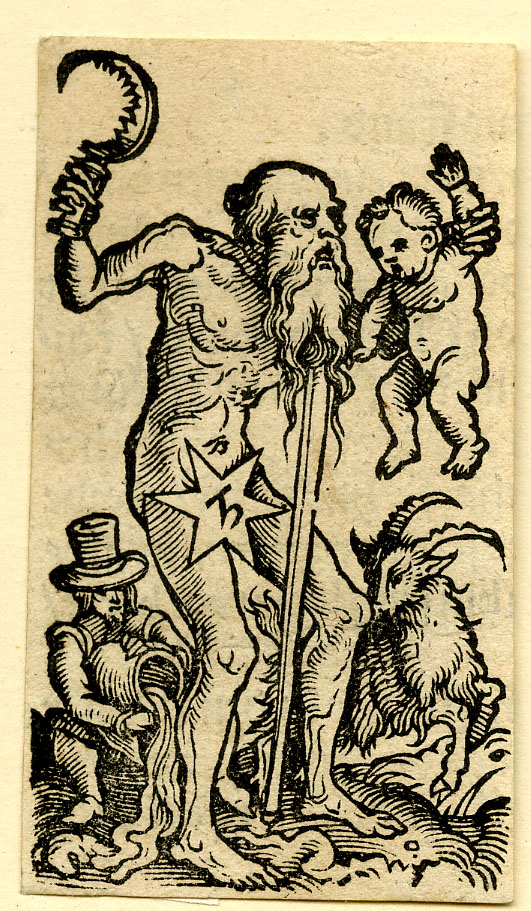
The most direct visual evidence for the hexagram-Saturn association comes from the British Museum's collection. German artist Hans Weiditz (c. 1495–1537) produced a series of woodcuts titled The Seven Planets between 1515 and 1536. His depiction of Saturn shows the god with his complete iconographic inventory: the sickle of time, the child he devours (the Kronos myth), the goat representing Capricorn, and the water-bearer representing Aquarius — Saturn's two ruling zodiac signs.
Most strikingly, a six-pointed star — a hexagram — appears prominently on his torso, with Saturn's own planetary glyph (♄) at its center. This is not scattered celestial decoration or constellation imagery. The hexagram, branded with Saturn's symbol, is placed among his defining iconographic attributes — equal in symbolic weight to his zodiac signs, his scythe, and the child he consumes. The British Museum catalog describes these woodcuts as depicting the planetary gods "with their attributes, symbols and representations of the respective signs of the Zodiac associated with them." The hexagram-with-Saturn-glyph is Saturn's attribute.
Note on Planetary Rulership: In traditional astrology, each planet "rules" specific zodiac signs. Saturn rules both Capricorn (the goat) and Aquarius (the water-bearer). These two signs appear in the Weiditz woodcut as confirmation of the figure's identity as Saturn — and the hexagram bearing his glyph appears among them as an equally defining attribute.
The Devourer and His Star
The Weiditz woodcut depicts Saturn in his classical Greco-Roman form: Kronos, the Titan who devoured his own children. The infant held aloft is not incidental decoration — it is Saturn's defining mythological act. Yet on his torso appears the hexagram, marked with his own planetary symbol.
This iconography resonates with the biblical conjunction in Amos 5:26, where the prophet condemns Israel for bearing both "the tabernacle of your Moloch" and "Chiun your images, the star of your god." Moloch — the deity who received child sacrifice — appears alongside Chiun (Saturn) and his star in the same breath of condemnation.
Ancient sources reinforce this connection. Diodorus Siculus (1st century BCE) describes Carthaginian child sacrifice to Kronos (Saturn). Roman writers identified Carthaginian Baal Hammon with Saturn. The pattern is consistent: Saturn is the child-devourer, and his star accompanies the cult of child sacrifice.
The Weiditz woodcut, created millennia after Amos, nonetheless preserves this conjunction visually: the god who devours children bears the hexagram — marked with his own glyph — as his attribute. The symbol and the sacrifice remain bound together.
Note: This connection is typological and iconographic, not a claim of direct historical transmission. The woodcut reflects Greco-Roman Kronos mythology, not conscious engagement with Amos 5:26. The resonance is documented, not explained.
For the biblical conjunction of Moloch and Saturn's star, see the discussion of Amos 5:26 in Section 1. For the "war on the seed" pattern, see Section 10. For Saturn's place in later esoteric tradition, see Section 14 (The Black Sun).
Saturn and the Dragon (Book II, Chapter 38)
Agrippa describes the talismanic images of Saturn:
"For they made, from the operations of Saturn, Saturn ascending in a stone, which is called the Loadstone, the Image of a man, having the countenance of an Hart, and Camels feet and sitting upon a Chayr or Dragon, holding in his right hand, a sithe, in his left hand a dart." — Agrippa, Three Books of Occult Philosophy, Book II, Chapter 38
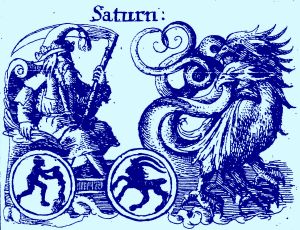
Saturn is depicted enthroned upon a dragon. The accompanying illustration from the 1651 English edition shows the old man with his scythe alongside a dragon-like creature, with medallions depicting Capricorn (the goat) and Aquarius beneath — Saturn's two ruling zodiac signs.
The Dragon's Tail and the "Evill Genius" (Book II, Chapter 45)
More significantly, Agrippa's chapter on the lunar nodes — the "Dragon's Head and Tail" — explicitly connects the dragon-serpent to Saturnine malefic influence:
"But they made the Image of the taile like as when the Moon Ecclipsed, in the Taile, or ill affected by Saturn or Mars, and they made it to introduce, anguish, infirmity and misfortune; and they called it the evill Genius." — Agrippa, Three Books of Occult Philosophy, Book II, Chapter 45
The Dragon's Tail, when combined with Saturn or Mars, produces an "evill Genius" — a malefic spirit bringing anguish and misfortune. This is the inverse of the Dragon's Head, which represents "a good and fortunate Genius."
Visual Evidence: Hexagrams in the Dragon
The illustration accompanying Chapter 45 in the 1651 English edition depicts the serpentine dragon of the lunar nodes with six-pointed stars embedded throughout its form. Crucially, this image was not created for Agrippa's magical treatise. The woodcut derives from Hyginus's Poeticon Astronomicon, a 1st-century BCE astronomical work first printed with illustrations in Venice (1482) by Erhard Ratdolt. In the Hyginus original, the constellation Draco encloses Ursa Minor, and the six-pointed figures function as conventional astronomical notation marking star positions.
When the 1651 editors repurposed this astronomical image for Agrippa's chapter "Of the Dragon's Head ☊ and the Dragon's Tail ☋," no new symbols were added; only the interpretive frame was altered. The hexagrams were not designed as Saturnine or magical signs but inherited from astronomical convention. Yet when placed alongside Agrippa's discussion of the Dragon's Tail in conjunction with Saturn producing an "evill Genius," these pre-existing symbols acquired additional malefic significance through contextual juxtaposition. This illustrates organic symbolic accretion across disciplinary boundaries (astronomy, astrology, and magic) rather than conscious symbolic design.
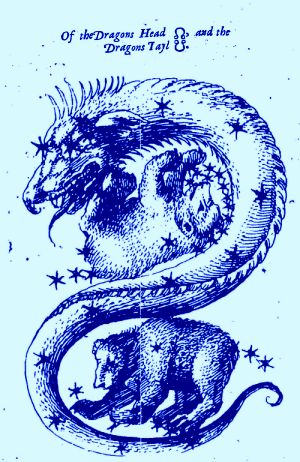
This visual evidence demonstrates that by the Renaissance:
- The dragon/serpent was associated with Saturn's malefic operations
- The hexagram (six-pointed star) was the stellar symbol embedded in Saturnine dragon imagery
- The combination produced an "evill Genius" — a malevolent spirit
The Significance
Agrippa does not mention Remphan or Chiun. However, his Saturn-dragon-hexagram nexus provides crucial evidence of transmission:
| Ancient Layer | Medieval Layer | Renaissance Layer |
|---|---|---|
| Chiun/Remphan = Saturn (Amos 5:26, Acts 7:43) | Seal of Solomon = demon-binding authority | Saturn depicted with dragon |
| Saturn worship condemned as astral idolatry | Arabic sources link hexagram to Solomon's seal (Scholem) | Dragon illustrated with hexagrams |
| — | Incantation bowls invoke Solomonic sealing | Dragon + Saturn = "evill Genius" |
By 1533, the hexagram was functioning as a Saturnian symbol in Western planetary magic. The geometric logic reinforces this: the hexagram's six points correspond to Saturn's position as the sixth planet in geocentric cosmology, and the number six encodes both cosmic harmony (six days of creation) and Saturnian limitation and boundary.
A Hebrew Talisman
Agrippa concludes Chapter 45 with a historical anecdote:
"Such an Image a certain Hebrew had included in a golden Belt full of Jewels, which Blanch the daughter of the Duke of Borbon (either willingly or ignorantly) bestowed on her husband Peter King of Spain, the first of that name, with which when he was girt, he seemed to himself to be compassed about with a Serpent; and afterwards finding the Magicall virtue fixed in the girdle, for this cause he forsook his wife." — Agrippa, Three Books of Occult Philosophy, Book II, Chapter 45
A Jewish magical practitioner created a dragon talisman — presumably incorporating the Saturn-hexagram imagery — which produced the sensation of being "compassed about with a Serpent." This connects the Saturn-dragon-hexagram tradition directly to Jewish magical practice in the medieval/Renaissance period.
Conclusion
Agrippa's Three Books of Occult Philosophy provides primary source evidence — both textual and visual — that by the 16th century, the hexagram was embedded in Saturn-dragon imagery associated with malefic spiritual influence. This does not prove an ancient Remphan-hexagram connection, but it demonstrates the post-medieval continuity of the Saturn-hexagram association, making the inferential transmission hypothesis plausible.
The condemned star of Amos 5:26 (Saturn/Chiun) → the Solomonic sealing tradition → the Renaissance hexagram-Saturn talisman: the chain, while not unbroken, shows consistent symbolic logic across centuries.
5. The Incantation Bowl: Early Hexagramic Sealing Practice
Evidentiary Status: Archaeological artifact + interpretive analysis.
A 5th–8th century Jewish Babylonian Aramaic incantation bowl provides crucial evidence for early hexagramic sealing practice. The bowl shows a central bound demon with six radiating chains converging at a binding point—an early, non-standardized hexagramic sealing form. The inscription explicitly invokes "the seal of King Solomon" (ḥotam Shelomo) to imprison the demon.
[Citation: Pending museum/collection identification; cf. Dan Levene, A Corpus of Magic Bowls (2003); Shaul Shaked, "Aramaic Bowl Inscriptions" in Encyclopaedia Iranica]
This is significant for three reasons:
- It demonstrates that hexagramic sealing logic was already functioning in Jewish magical practice centuries before medieval grimoires standardized the geometric form.
- It fills a genuine gap in the symbol's developmental history—the hexagram did not appear fully formed in medieval sources but emerged from earlier visual-sealing grammar.
- The explicit Solomonic invocation contextualizes the visual element as operative (functional demon-binding), not decorative.
Interpretive Note: The bowl itself does not reference Remphan, Saturn, or astral worship. The connection between the hexagram and Saturn is established through separate biblical and scholarly evidence. However, the bowl demonstrates that the form later associated with Saturn in magical traditions was already functioning as Solomon's seal in Late Antiquity.
6. Solomon's Ironic Fall
Evidentiary Status: Biblical text.
The man credited with sealing authority over demons ultimately fell to the very gods associated with Remphan's star:
"For it came to pass, when Solomon was old, that his wives turned away his heart after other gods: and his heart was not perfect with the LORD his God, as was the heart of David his father. For Solomon went after Ashtoreth the goddess of the Zidonians, and after Milcom the abomination of the Ammonites. And Solomon did evil in the sight of the LORD, and went not fully after the LORD, as did David his father. Then did Solomon build an high place for Chemosh, the abomination of Moab, in the hill that is before Jerusalem, and for Molech, the abomination of the children of Ammon." — 1 Kings 11:4–7 (KJV)
This is not incidental. Solomon built infrastructure for Molech worship—the same deity paired with Remphan's star in Acts 7:43 and Amos 5:26. The seal-master falls to the sealed forces, demonstrating that human subversion of demonic power remains incomplete without divine intervention.
The judgment would be comprehensive. Solomon built the Temple where God's Name dwelt (1 Kings 8:29); Solomon also built high places for Molech (1 Kings 11:7). In 586 BCE, Nebuchadnezzar burned both — the legitimate house and the illegitimate cause of its destruction collapsed together. The seal-master's legacy was consumed by the very Babylon whose gods he had elevated.
Part II: The Seed War
7. Molech and the Attack on Messianic Promise
Evidentiary Status: Biblical text + theological interpretation.
The star of Remphan is not associated with abstract idolatry. Scripture explicitly bundles it with Molech worship—and Molech worship specifically demanded child sacrifice:
"And thou shalt not let any of thy seed pass through the fire to Molech, neither shalt thou profane the name of thy God: I am the LORD." — Leviticus 18:21 (KJV)
"Whosoever he be of the children of Israel, or of the strangers that sojourn in Israel, that giveth any of his seed unto Molech; he shall surely be put to death: the people of the land shall stone him with stones. And I will set my face against that man, and will cut him off from among his people; because he hath given of his seed unto Molech, to defile my sanctuary, and to profane my holy name." — Leviticus 20:2–3 (KJV)
"And they built the high places of Baal, which are in the valley of the son of Hinnom, to cause their sons and their daughters to pass through the fire unto Molech; which I commanded them not, neither came it into my mind, that they should do this abomination, to cause Judah to sin." — Jeremiah 32:35 (KJV)
"And he defiled Topheth, which is in the valley of the children of Hinnom, that no man might make his son or his daughter to pass through the fire to Molech." — 2 Kings 23:10 (KJV)
8. "Seed": The Operative Word
The Hebrew word in Leviticus 18:21 is zera (זֶרַע)—"seed," meaning offspring or lineage. This is not random vocabulary. It is the same word used in the foundational messianic prophecy:
"And I will put enmity between thee and the woman, and between thy seed and her seed; it shall bruise thy head, and thou shalt bruise his heel." — Genesis 3:15 (KJV)
Paul explicitly identifies this "seed" as Christ:
"Now to Abraham and his seed were the promises made. He saith not, And to seeds, as of many; but as of one, And to thy seed, which is Christ." — Galatians 3:16 (KJV)
Within this theological framework, the Molech system takes on strategic significance beyond mere cultural practice. If "seed" carries messianic weight—as Paul argues—then child sacrifice represents an assault on the lineage through which the promised Deliverer would come. This interpretation is theological, not historical-sociological; it reads ancient practice through the lens of redemptive purpose.
The star of Remphan, biblically bundled with Molech worship, is thus associated with a system designed to annihilate the very lineage through which salvation would come.
9. "Profane the Name": Corruption of Divine Authority
Leviticus 18:21 contains a second significant phrase: "neither shalt thou profane the name of thy God."
This is striking because the entire Solomonic tradition is built on name authority:
- Solomon binds demons by invoking divine names
- The incantation bowls use names to seal demons
- The Testament of Solomon emphasizes naming as the mechanism of power
Molech worship "profanes the name"—it corrupts and inverts the authority structure. Instead of God's name binding evil, the satanic system uses false worship to defile God's name and usurp His authority.
The profanation reached its terminus when the Temple — the dwelling place of the Name (1 Kings 8:29) — was burned by Babylon (2 Kings 25:9). The house of the Name was destroyed because the Name had been profaned.
The Remphan/Molech system thus attacks on two fronts:
- Seed destruction: Eliminate the messianic line through child sacrifice
- Name profanation: Corrupt divine authority and the power to bind evil
10. The Complete Inversion Pattern
Christ's victory precisely reverses every element of the satanic system:
The Molech/Remphan System:
- Demands seed (children) be destroyed through sacrifice
- Children sacrificed TO the false god
- Profanes God's name, corrupting divine authority
- Star symbol represents the death cult's allegiance
Christ's Victory:
- THE Seed (Christ) survives and destroys the destroyer
- God sacrifices Himself FOR humanity
- Christ is given "the name above every name" (Philippians 2:9)
- Star/seal becomes the lock on Satan's prison
"Wherefore God also hath highly exalted him, and given him a name which is above every name: That at the name of Jesus every knee should bow, of things in heaven, and things in earth, and things under the earth." — Philippians 2:9–10 (KJV)
The pattern played out historically before it was completed spiritually. When Babylon conquered Jerusalem, Zedekiah's sons were killed before his eyes — then his eyes were put out (2 Kings 25:7). The last image the Davidic king saw was his seed destroyed. The system that demanded children in Topheth's fire now destroyed royal offspring by Babylon's sword. Same target, different instrument. But the Seed promised in Genesis 3:15 — identified by Paul as Christ (Galatians 3:16) — could not be extinguished. What Babylon's sword began, Rome's cross attempted to finish. Both failed.
11. Gehenna: How the Destroyer's Ground Became the Destroyer's Prison
Evidentiary Status: Biblical text + linguistic fact + geographic confirmation.
The word "Gehenna"—used by Jesus for Hell—is not a metaphor. It is a real place: the Valley of Hinnom (Ge-Hinnom, גֵּיא הִנֹּם), located on the south side of Jerusalem. As established in Section 3, the Baal and Molech worshipped at this site were manifestations of the same unified system—the child-devouring cult whose star Stephen condemns. This is where that system operated. This is where children were sacrificed. And this is the site whose name became the word for eternal punishment.
The destroyer's ground became the destroyer's prison.
The Etymology: "Son of Lamentation"
The valley's Hebrew name carries its own testimony. Ben-Hinnom (בֶּן־הִנֹּם) is composed of two elements:
| Component | Hebrew | Meaning |
|---|---|---|
| בֶּן | Ben | "Son of" |
| הִנֹּם | Hinnom | "Lamentation," "Groaning," "Wailing" |
The valley was literally named "Son of Lamentation"—the sound of parents watching their children burn. The site's name preserves the crime's testimony.
The Linguistic Transformation
The name underwent systematic contraction as its meaning solidified:
| Stage | Form | Language |
|---|---|---|
| Original | Gē ben-Hinnōm | Hebrew |
| Contracted | Gē-Hinnōm | Hebrew |
| Grecized | Gehenna (Γέεννα) | Greek |
| English | Gehenna / Hell | English translations |
Jeremiah's Triple Condemnation
Jeremiah condemns the Topheth/Ben-Hinnom child sacrifice three times. This repetition emphasizes the severity of the sin and the certainty of judgment.
First Condemnation: Jeremiah 7:30-32
"For the children of Judah have done evil in my sight, saith the LORD: they have set their abominations in the house which is called by my name, to pollute it. And they have built the high places of Topheth, which is in the valley of the son of Hinnom, to burn their sons and their daughters in the fire; which I commanded them not, neither came it into my heart. Therefore, behold, the days come, saith the LORD, that it shall no more be called Topheth, nor the valley of the son of Hinnom, but the valley of slaughter: for they shall bury in Topheth, till there be no place." — Jeremiah 7:30-32 (KJV)
Key elements: Location specified (Valley of the Son of Hinnom). Practice specified (burn sons and daughters in fire). God's explicit denial ("which I commanded them not, neither came it into my heart"). Prophetic renaming ("Valley of Slaughter"). Judgment (they who slaughtered will be slaughtered there).
Second Condemnation: Jeremiah 19:4-6
"Because they have forsaken me, and have estranged this place, and have burned incense in it unto other gods, whom neither they nor their fathers have known, nor the kings of Judah, and have filled this place with the blood of innocents; They have built also the high places of Baal, to burn their sons with fire for burnt offerings unto Baal, which I commanded not, nor spake it, neither came it into my mind: Therefore, behold, the days come, saith the LORD, that this place shall no more be called Topheth, nor The valley of the son of Hinnom, but The valley of slaughter." — Jeremiah 19:4-6 (KJV)
Key elements: "Blood of innocents"—explicit acknowledgment of child murder. Baal named as recipient of the sacrifices. Same denial formula ("which I commanded not, nor spake it, neither came it into my mind"). Same prophetic renaming ("Valley of Slaughter").
Third Condemnation: Jeremiah 32:35
"And they built the high places of Baal, which are in the valley of the son of Hinnom, to cause their sons and their daughters to pass through the fire unto Molech; which I commanded them not, neither came it into my mind, that they should do this abomination, to cause Judah to sin." — Jeremiah 32:35 (KJV)
Key elements: All three names in one verse—Valley of Ben-Hinnom + Baal + Molech. Confirms the unified system (Baal and Molech at same location, as established in Section 3). Same denial formula repeated a third time. Called "this abomination"—strongest possible condemnation.
The Denial Formula
Note the remarkable phrase repeated in all three passages:
"Which I commanded them not, neither came it into my heart/mind"
This is God's strongest possible repudiation. Not merely "I didn't command this" but "it never even entered my mind." Child sacrifice is so antithetical to God's nature that He explicitly states the thought itself is foreign to Him.
This directly counters any claim that Molech worship was a corruption of YHWH worship or somehow compatible with it. God declares the practice utterly alien to His character. The unified system was demonic, not divine.
Josiah's Defilement
"And he defiled Topheth, which is in the valley of the children of Hinnom, that no man might make his son or his daughter to pass through the fire to Molech." — 2 Kings 23:10 (KJV)
Historical context: Josiah's reforms (~622 BCE) were the most sweeping in Judah's history. He systematically destroyed pagan worship sites throughout the land. The Topheth was specifically defiled—made ritually unusable. Tradition holds he dumped garbage, sewage, and unclean materials there. This is why Gehenna became associated with burning refuse and decay.
| Stage | Name | Meaning/Status |
|---|---|---|
| 1. Original | Gē ben-Hinnōm | "Valley of the Son of Lamentation" |
| 2. Common usage | Topheth | The specific high place/altar site |
| 3. Prophetic | "Valley of Slaughter" | Jeremiah's renaming (19:6) |
| 4. Post-Josiah | Defiled ground | Ritually destroyed, unusable |
| 5. Intertestamental | Garbage dump | Perpetual fires burning refuse |
| 6. Greek | Gehenna (Γέεννα) | Grecized form |
| 7. Jesus's usage | Gehenna | The place of eternal punishment |
| 8. English | Hell | Standard translation |
Jesus's Gehenna Teachings
Jesus uses the term "Gehenna" (Γέεννα) specifically—not generic words for death or the grave. He deliberately invokes the Valley of Ben-Hinnom and all its associations. His audience knew exactly what He meant: the place where children were burned to Molech.
"But I say unto you, That whosoever is angry with his brother without a cause shall be in danger of the judgment: and whosoever shall say to his brother, Raca, shall be in danger of the council: but whosoever shall say, Thou fool, shall be in danger of hell fire [Gehenna of fire]." — Matthew 5:22 (KJV)
"And fear not them which kill the body, but are not able to kill the soul: but rather fear him which is able to destroy both soul and body in hell [Gehenna]." — Matthew 10:28 (KJV)
"Ye serpents, ye generation of vipers, how can ye escape the damnation of hell [Gehenna]?" — Matthew 23:33 (KJV)
"And if thy hand offend thee, cut it off: it is better for thee to enter into life maimed, than having two hands to go into hell [Gehenna], into the fire that never shall be quenched: Where their worm dieth not, and the fire is not quenched. And if thy foot offend thee, cut it off: it is better for thee to enter halt into life, than having two feet to be cast into hell [Gehenna], into the fire that never shall be quenched: Where their worm dieth not, and the fire is not quenched. And if thine eye offend thee, pluck it out: it is better for thee to enter into the kingdom of God with one eye, than having two eyes to be cast into hell fire [Gehenna]: Where their worm dieth not, and the fire is not quenched." — Mark 9:43-48 (KJV)
Note: Mark 9:48 quotes Isaiah 66:24—"their worm dieth not, and the fire is not quenched." Jesus connects the Gehenna judgment to Isaiah's prophecy of final judgment. The Rephaim who dwell in Sheol beneath this valley greet the fallen morning star (Isaiah 14:9), as discussed in Section 13.
The Betrayer's End: Akeldama
A geographic connection reinforces this theological pattern. Judas's betrayal money purchased a field in the same cursed valley:
"And the chief priests took the silver pieces, and said, It is not lawful for to put them into the treasury, because it is the price of blood. And they took counsel, and bought with them the potter's field, to bury strangers in. Wherefore that field was called, The field of blood, unto this day." — Matthew 27:6-8 (KJV)
Acts 1:18-19 adds that Judas himself fell headlong in this field, "and all his bowels gushed out," leading locals to call it "Akeldama, that is to say, The field of blood."
Akeldama lies at the southern end of the Hinnom Valley, overlooking the very slopes where children were once sacrificed to Molech. The location is not incidental. Judas—who betrayed the Seed for thirty pieces of silver—met his gruesome end in the valley of child sacrifice, where Molech's fire once burned. His blood money purchased ground in the same geography where parents had once purchased false promises with their children's lives.
| Molech Worship | Judas's Betrayal |
|---|---|
| Children sacrificed for promised blessing | The Son sacrificed for promised silver |
| Valley defiled by innocent blood | Field purchased with blood money |
| Named "Valley of Slaughter" | Named "Field of Blood" |
| Parents destroyed their offspring | Betrayer destroyed by his own fall |
The geography speaks: where the seed of Abraham was once devoured, the instrument of the Seed's betrayal was himself devoured.
The Complete Inversion
The theological pattern completes itself. The site where Satan's system achieved its greatest victories over the seed becomes the name of Satan's eternal defeat:
| The Molech System | Christ's Gehenna |
|---|---|
| Children cast into fire | The wicked cast into fire |
| Parents sacrifice children to false god | God sacrifices Himself for His children |
| Fire consumes the innocent seed | Fire consumes the guilty serpent |
| Valley named "Son of Lamentation" | Lamentation falls on those who caused it |
| Worshippers thought they gained favor | Worshippers receive eternal judgment |
| The destroyer devoured | The destroyer is devoured |
The pattern: Where innocent blood was shed → where guilty blood is required. Where the seed was destroyed → where the serpent is destroyed. The destroyer's ground → the destroyer's prison.
Jesus takes the site of Satan's greatest victory over the seed and makes it the name of Satan's eternal defeat.
Ben-Hinnom / Ben-Yah: The Linguistic Contrast
The linguistic contrast between Ben-Hinnom and Ben-Yahu (Benaiah) illuminates the binding narrative explored in Section 19:
| Hebrew | Name | Meaning | Role |
|---|---|---|---|
| בֶּן־הִנֹּם | Ben-Hinnom | "Son of Lamentation" | The PLACE where children are sacrificed to demons |
| בְּנָיָהוּ | Ben-Yahu (Benaiah) | "Son of Yah/YHWH" | The MAN who binds the demon king |
The structural parallel: Ben-Hinnom ("Son of Lamentation") — named for the cries of dying children. Ben-Yahu ("Son of God") — the one who binds Ashmedai with chain, signet ring, and the Divine Name.
The inversion: At Ben-Hinnom, the serpent's system devours the seed. Through Ben-Yahu, the serpent's king is bound. In Christ (THE Son of God), Gehenna becomes the serpent's prison.
The Geographic Testimony
The Valley of Ben-Hinnom's location is theologically significant:
| Direction | Location | Significance |
|---|---|---|
| North | Mount Zion | God's dwelling, the Temple |
| Center | Valley of Ben-Hinnom (Gehenna) | Child sacrifice site / boundary |
| South | Plain of Rephaim | Territory of the giants |
| Below | Sheol | Where Rephaim dwell as shades (Isaiah 14:9) |
The physical geography mirrors spiritual reality: Zion (God's presence) separated from the Plain of Rephaim (giants' territory) by Gehenna (the place of fire). The boundary between the holy and the demonic is marked by judgment.
The Babylon Connection: Poetic Justice Across Millennia
A striking detail appears when comparing Amos to Acts:
Amos 5:27: "I will cause you to go into captivity beyond Damascus"
Acts 7:43: "I will carry you away beyond Babylon"
Stephen changes the geography. Why? By his time, the Babylonian exile had already happened. He updates the reference — but the cause remains the same: "Ye took up the tabernacle of Moloch, and the star of your god Remphan."
This is not incidental redaction. It is theological commentary. Stephen recognizes the poetic justice: Israel was exiled to Babylon for worshiping Babylon's gods.
The Origin: Babylon's Gods
As established in Section 2, the Saturn cult that Amos condemns originated in Mesopotamia. The MUL.APIN tablets (~1000 BCE) name Saturn as Kajamānu — the same deity that appears in Hebrew as Chiun (כִּיּוּן) and in Greek as Remphan (Ῥαιφάν). The Babylonian expiatory prayers known as Šurpu pair "Sikkuth and Kajamānu" together — the same pairing that appears in Amos 5:26.
Israel did not invent this worship. They imported it. The cult was foreign. And the judgment was fitting.
The Prophetic Warnings: God Announces Babylon as Instrument of Judgment
God did not exile Israel without warning. Through Jeremiah, He announced Babylon by name as the coming instrument of judgment — decades before the destruction occurred.
Jeremiah 25:8–11 (~605 BCE):
"Therefore thus saith the LORD of hosts; Because ye have not heard my words, Behold, I will send and take all the families of the north, saith the LORD, and Nebuchadrezzar the king of Babylon, my servant, and will bring them against this land, and against the inhabitants thereof… And this whole land shall be a desolation, and an astonishment; and these nations shall serve the king of Babylon seventy years." — Jeremiah 25:8–11 (KJV)
Note the phrase: "Nebuchadrezzar the king of Babylon, my servant." God claims Babylon's king as His instrument. The nation that produced the Saturn cult will punish the nation that adopted it.
Jeremiah 20:4–6 (to Pashur the priest):
"For thus saith the LORD, Behold, I will make thee a terror to thyself, and to all thy friends: and they shall fall by the sword of their enemies, and thine eyes shall behold it… And thou, Pashur, and all that dwell in thine house shall go into captivity: and thou shalt come to Babylon, and there thou shalt die…" — Jeremiah 20:4–6 (KJV)
Jeremiah 29:10 (letter to the exiles already in Babylon):
"For thus saith the LORD, That after seventy years be accomplished at Babylon I will visit you, and perform my good word toward you, in causing you to return to this place." — Jeremiah 29:10 (KJV)
The prophecy is specific: seventy years. The destination is named. The cause is stated. And the mercy is promised.
The Historical Fulfillment: Deportation and Destruction
What Jeremiah prophesied, Kings and Chronicles record as accomplished fact.
First Deportation (~597 BCE) — 2 Kings 24:13–14:
"And he carried out thence all the treasures of the house of the LORD, and the treasures of the king's house… And he carried away all Jerusalem, and all the princes, and all the mighty men of valour, even ten thousand captives, and all the craftsmen and smiths: none remained, save the poorest sort of the people of the land. And he carried away Jehoiachin to Babylon…" — 2 Kings 24:13–14 (KJV)
Final Fall of Jerusalem (~586 BCE) — 2 Kings 24:20–25:7:
"For through the anger of the LORD it came to pass in Jerusalem and Judah, until he had cast them out from his presence… And in the ninth year of his [Zedekiah's] reign… Nebuchadnezzar king of Babylon came… And they slew the sons of Zedekiah before his eyes… and they put out his eyes, and bound him in fetters of brass, and carried him to Babylon." — 2 Kings 24:20–25:7 (KJV)
The detail is chilling: Zedekiah's sons killed before his eyes — then his eyes put out. The last thing the king of Judah saw was his seed destroyed. The Molech pattern operates at geopolitical scale: the king who served the child-devouring system watches his own offspring perish. Then darkness. The system that consumed children in Topheth's fire now destroys the royal line by Babylon's sword.
Final Destruction and Mass Deportation — 2 Kings 25:8–12:
"And in the fifth month, on the seventh day of the month… came Nebuzaradan, captain of the guard, a servant of the king of Babylon, unto Jerusalem: And he burnt the house of the LORD… So Judah was carried away captive out of their land." — 2 Kings 25:8–12 (KJV)
The Temple — where the "high places of Baal" and Molech worship had infiltrated (Jeremiah 32:35) — is burned. The land that hosted Babylon's gods is emptied and sent to Babylon.
2 Kings 25:20–21:
"…and they took them to the king of Babylon to Riblah… And the king of Babylon smote them, and slew them at Riblah in the land of Hamath. So Judah was carried away captive out of their land." — 2 Kings 25:20–21 (KJV)
The phrase repeats like a funeral knell: "So Judah was carried away captive out of their land."
The Complete Circuit
| Stage | Event | Source |
|---|---|---|
| Origin | Saturn cult (Kajamānu) emerges in Babylon | MUL.APIN (~1000 BCE) |
| Transmission | Babylonian religion migrates through Canaan | Cultural/archaeological evidence |
| Adoption | Israel imports Molech + Chiun + star | Amos 5:26 (~750 BCE) |
| Site | Valley of Ben-Hinnom becomes worship center | Jeremiah 7:31, 19:5, 32:35 |
| Warning | God announces Babylon as judgment | Jeremiah 25:8–11 (~605 BCE) |
| First Exile | Ten thousand carried to Babylon | 2 Kings 24:13–14 (~597 BCE) |
| Final Destruction | Temple burned, mass deportation | 2 Kings 25:8–12 (~586 BCE) |
| Stephen's Update | "I will carry you away beyond Babylon" | Acts 7:43 (~33 CE) |
| Eschatological Symbol | "Babylon" = the satanic world-system | Revelation 17–18 |
Babylon as Eschatological Archetype
The circuit does not end with the historical exile. In Revelation, "Babylon" becomes the name for the entire satanic system — the final iteration of the sovereignty cult that began with Nimrod, demanded children through Molech, bore the star of Remphan, and killed the prophets.
"Babylon the great is fallen, is fallen, and is become the habitation of devils, and the hold of every foul spirit." — Revelation 18:2 (KJV)
"And in her was found the blood of prophets, and of saints, and of all that were slain upon the earth." — Revelation 18:24 (KJV)
The place where Babylon's gods were worshipped became the word for Hell (Gehenna). The culture that produced Remphan became the prophetic name for ultimate evil. The system that demanded seed is judged by the Seed it could not destroy.
Scripture traces cause and effect across millennia: from Babylon's tablets to Israel's high places to Jerusalem's valley to Babylon's conquest to Revelation's collapse. The arc bends toward justice.
12. Historical Witness: Milton's Paradise Lost (1667)
Evidentiary Status: Historical corroboration.
The connections traced in this theory are not modern discoveries. John Milton—17th-century Cambridge scholar, Hebraist, and author of the most influential Christian epic in English—made them explicit in Paradise Lost:
"First, Moloch, horrid King, besmeared with blood / Of human sacrifice, and parents' tears; / Though, for the noise of drums and timbrels loud, / Their children's cries unheard that passed through fire / To his grim idol. Him the Ammonite / Worshiped in Rabba and her watery plain... / Nor content with such / Audacious neighbourhood, the wisest heart / Of Solomon he led by fraud to build / His temple right against the temple of God / On that opprobrious hill, and made his grove / The pleasant valley of Hinnom, Tophet thence / And black Gehenna called, the type of Hell." — Paradise Lost, Book I, lines 391–405
Milton traces precisely what this theory traces:
- Molech = child sacrifice ("besmeared with blood of human sacrifice")
- Children burned alive ("passed through fire to his grim idol")
- Solomon fell to Molech ("the wisest heart of Solomon he led by fraud")
- Solomon built Molech's temple facing God's Temple ("right against the temple of God")
- Valley of Hinnom = Gehenna = Hell ("black Gehenna called, the type of Hell")
Independent Convergence
The connections in this paper were traced independently—through Genesis, Leviticus, Amos, Acts, Kings, and Revelation—before the author encountered Milton's parallel work. Two interpreters, 350 years apart, reading the same texts, arrived at substantially similar conclusions.
This convergence suggests the pattern is textually grounded rather than externally imposed. Milton recognized it within the conventions of 17th-century biblical scholarship. This theory recognizes it within contemporary hermeneutical frameworks. The persistence of the pattern across interpretive contexts—while not constituting proof—provides corroborating evidence that the biblical authors themselves intended these connections.
Critics who characterize this synthesis as arbitrary "pattern-matching" must account for Milton's independent arrival at the same nexus of Molech, Solomon, Hinnom, and Gehenna. His Paradise Lost remains a canonical work of English literature, taught at major universities worldwide. The question is not whether such connections can be drawn, but whether they accurately reflect the biblical text's internal logic.
Part III: The Theological Synthesis
Evidentiary Status: Christian typological interpretation.
The following sections present a theological framework for understanding the hexagram's symbolic trajectory. This is interpretation, not historical proof—but it is coherent interpretation grounded in the evidence presented above.
13. The Counterfeit Morning Star, the Rephaim, and the Pattern of Fallen Stars
Isaiah 14 describes a fallen figure aspiring above God's stars. But the passage contains more than most readers notice—three verses before the famous "How art thou fallen," the text introduces a critical connection.
Isaiah 14:9-12: The Full Descent
"Hell [Sheol] from beneath is moved for thee to meet thee at thy coming: it stirreth up the dead [רְפָאִים — REPHAIM] for thee, even all the chief ones of the earth; it hath raised up from their thrones all the kings of the nations. All they shall speak and say unto thee, Art thou also become weak as we? art thou become like unto us? Thy pomp is brought down to the grave, and the noise of thy viols: the worm is spread under thee, and the worms cover thee. How art thou fallen from heaven, O Lucifer, son of the morning! how art thou cut down to the ground, which didst weaken the nations!" — Isaiah 14:9-12 (KJV)
The Hebrew word translated "the dead" in verse 9 is רְפָאִים — Rephaim. These are not ordinary deceased humans. The Rephaim are the shades of the giants — the "mighty ones" and "chief ones of the earth" who once walked as kings and now dwell as shadows in Sheol.
Who Are the Rephaim?
The Rephaim appear throughout Scripture as a distinct category of beings:
- Genesis 6:1-4: The Nephilim/giants originate from the union of "sons of God" with human women
- Genesis 14:5, 15:20: Rephaim listed as a nation, dwelling at cultic sites (Ashteroth Karnaim — "Ashtoreth of the Two Horns")
- Deuteronomy 2-3: Rephaim described as giants; Og of Bashan numbered among the last of them
- 2 Samuel 21:15-22: David's men slay the remaining Rephaim — Goliath's brothers, descendants of "the giant" (הָרָפָה, ha-Rapha)
- Isaiah 14:9: The Rephaim now dwell as shades in Sheol — and they rise to greet the fallen morning star
- Isaiah 26:14: "They are dead, they shall not live; they are Rephaim, they shall not rise"
The giants who corrupted the earth, who dwelt at the temples of Baal and Ashtoreth, who warred against God's people — they now reside in Sheol. And when the "son of the morning" falls, they rise to welcome him.
Classical sources preserve a structurally analogous pattern. Hyginus (Fabulae, 1st c. BCE) records that the Gigantes, including Typhon the dragon-serpent, were born "ex terra & tartaro" and were subsequently confined to Tartarus. The correspondence is ontological rather than textual: giants of primordial origin, rebellion against divine order, defeat, and confinement in the underworld.
Biblical tradition locates the Rephaim in Sheol (Isaiah 14:9); classical tradition locates the Giants in Tartarus. Both depict fallen powers encountered by descending figures and associated with rebellion and judgment. This convergence does not imply borrowing but reflects a shared ancient cosmology recognizing primordial rebellion and subterrestrial confinement.
The Geographic Convergence
This connection gains force when mapped against the geography established in Section 11:
| Location | What Dwells There |
|---|---|
| Mount Zion (north) | God's presence |
| Valley of Ben-Hinnom / Gehenna (center) | Site of child sacrifice → word for Hell |
| Plain of Rephaim (south) | Territory of the giants |
| Sheol (below) | Where Rephaim dwell as shades (Isaiah 14:9) |
The fallen morning star descends to join the Rephaim in Sheol — directly beneath the plain that bore their name, adjacent to Gehenna where their system demanded children. The Saturn/Remphan star-worship condemned in Amos 5:26 and Acts 7:43 (see Section 3) finds its ultimate figure in this fallen "son of the morning."
A Note on Sacred Geography
The traditional Tomb of King David — venerated by Jews, Christians, and Muslims for over a millennium — is located on Mount Zion, near the Zion Gate. While scholars note that the Bible places David's burial in the "City of David" (1 Kings 2:10), a lower ridge to the southeast, the traditional site has been honored since at least the 9th century CE.
What makes this tradition striking is the building's structure: the Cenacle — the Upper Room where Jesus celebrated the Last Supper — sits directly above David's traditional tomb in the same compound. The "Root and Offspring of David" (Revelation 22:16) is literally commemorated above David.
Whether or not David's bones rest there, the sacred geography is remarkable: Mount Zion (David's memorial, Christ's Last Supper) overlooks Gehenna (the Valley of Ben-Hinnom) to the south, with the Plain of Rephaim beyond. The man who killed the Rephaim is commemorated on the hill overlooking their former territory — separated by the valley of judgment. And the One who defeats what the Rephaim served is positioned directly above him.
The architecture encodes the theology: David below, Christ above, Gehenna between Zion and the giants' plain, Sheol beneath all — where the Rephaim await (Isaiah 14:9).
David and the Rephaim: Completing the Conquest
This connection reinforces the significance of Christ's title "Root and Offspring of David" (Revelation 22:16).
Goliath's Lineage Confirmed
Goliath was not merely a large man — he was a member of the Rephaim, the race of giants marked for displacement in God's covenant promise to Abraham (Genesis 15:20). Scripture explicitly identifies him as a descendant of Rapha, and his brother Lahmi is directly called a Rephaim:
"And there was again war with the Philistines; and Elhanan the son of Jair slew Lahmi the brother of Goliath the Gittite, whose spear staff was like a weaver's beam." — 1 Chronicles 20:5 (KJV)
"These four were born to the giant [הָרָפָה, ha-Rapha] in Gath, and fell by the hand of David, and by the hand of his servants." — 2 Samuel 21:22 (KJV)
The Rephaim were associated with regions such as Bashan and Gath, and their presence in Canaan is documented throughout the conquest narratives (Deuteronomy 2:10–11, 20–21; 3:11). While some traditions connect the Rephaim to the Nephilim of Genesis 6, the Bible places Goliath's lineage firmly within the Rephaim — the giants who dwelt at cultic centers like Ashteroth Karnaim (Genesis 14:5) and served the unified Baal/Saturn system.
The Incomplete Conquest
Joshua's conquest removed most of the Anakim (a Rephaim subgroup), but not all:
"There was none of the Anakim left in the land of the children of Israel: only in Gaza, in Gath, and in Ashdod, there remained." — Joshua 11:22 (KJV)
Gath. The very city where Goliath and his brothers would later emerge to challenge Israel.
David Completes What Joshua Began
| Passage | What Happened |
|---|---|
| 1 Samuel 17 | David slays Goliath — Rephaim from Gath |
| 2 Samuel 21:15-22 | David's men slay 4 more Rephaim (Goliath's brothers) |
| 1 Chronicles 20:4-8 | Parallel account — explicitly calls them "Rephaim" |
| 2 Samuel 21:22 | "These four were born to the giant in Gath, and fell by the hand of David" |
David did not merely kill a champion. He ended a lineage that had:
- Corrupted origins (connected to Nephilim tradition)
- Cultic function (dwelt at temple sites of Ashtoreth/Baal)
- Opposed God's covenant people for centuries
- Been marked for displacement since Abraham (Genesis 15:20)
The Pattern Completed in Christ
David physically defeated the Rephaim on earth.
Christ spiritually defeats the powers they served — the unified system whose star Stephen condemns (Acts 7:43), whose shades greet the fallen morning star in Sheol (Isaiah 14:9).
The "Root and Offspring of David" completes what David began:
- David killed the giants → Christ defeats the powers behind them
- David wielded Goliath's own sword against him (1 Samuel 17:51) → Christ defeats death by death (Hebrews 2:14)
The seed war that began in Genesis 3:15 — the serpent's seed against the woman's seed — reached a physical climax when David slew the Rephaim. It reaches its cosmic climax when Christ, David's greater Son, binds the serpent himself with chain and seal (Revelation 20:1-3) and reclaims the Morning Star title (Revelation 22:16).
Demonic Spirits from Primordial Darkness
Hyginus's cosmogony opens with the formula: "Ex Caligine, Chaos. Ex Chao & Caligine, Nox, Dies, Erebus, Aether." Darkness precedes and generates the ordered cosmos. From Night (Nox) and Darkness (Erebus), Hyginus lists Phantasmata (apparitions), Incubones (nightmare spirits), Morpheus, Phobetor ("the frightener"), and Phantasos.
Classical tradition thus recognized malevolent or liminal spirits as originating from primordial darkness itself. This parallels the Enochic account (1 Enoch 15:8–12), where the spirits of the slain giants become earthbound demons. Though articulated differently, both traditions identify disembodied, disruptive spirits emerging from primordial rebellion and judgment.
The Counterfeit Light
"Helel ben Shahar" (הֵילֵל בֶּן־שָׁחַר) translates as "Shining One, Son of the Dawn"—a Morning Star title. While the immediate referent is Babylon's king, Christian tradition has applied this typologically to Lucifer's primordial rebellion. In Mesopotamian astrology, Saturn was the "Night-Sun"—a dark counterpart to true light—fitting the pattern of counterfeit illumination.
This establishes a theological motif: false light masquerading as true. Paul echoes this:
"And no marvel; for Satan himself is transformed into an angel of light." — 2 Corinthians 11:14 (KJV)
The Pattern of Fallen Stars
Revelation continues this pattern with another fallen star bringing death:
"And the third angel sounded, and there fell a great star from heaven, burning as it were a lamp, and it fell upon the third part of the rivers, and upon the fountains of waters; And the name of the star is called Wormwood: and the third part of the waters became wormwood; and many men died of the waters, because they were made bitter." — Revelation 8:10–11 (KJV)
The fallen star "Wormwood" poisons the waters and brings mass death. Strikingly, the Hebrew word for wormwood (לַעֲנָה, la'anah) appears in Amos 5:7—just two verses before the Remphan condemnation:
"Ye who turn judgment to wormwood, and leave off righteousness in the earth." — Amos 5:7 (KJV)
The same chapter that condemns the "star of your god" also invokes wormwood as a symbol of Israel's corruption. Scripture consistently associates fallen/counterfeit stars with death, poison, and judgment:
- Lucifer/Helel (Isaiah 14): Falls from heaven, greeted by Rephaim, counterfeit Morning Star
- Remphan's star (Acts 7, Amos 5): Astral idol bundled with child sacrifice
- Wormwood (Revelation 8:10–11): Falls from heaven, poisons waters, brings death
- Abaddon/Apollyon (Revelation 9:11): King of the abyss, the Destroyer—linked by early Church Fathers to Apollo, the false light/plague god
Christ Reclaims the Title
Against this backdrop of counterfeit stars bringing death, Christ's declaration becomes all the more pointed:
"I Jesus have sent mine angel to testify unto you these things in the churches. I am the root and the offspring of David, and the bright and morning star." — Revelation 22:16 (KJV)
Note the dual claim:
- Root of David: Existed before David — eternal preexistence
- Offspring of David: Born in David's line — human descent
- Bright Morning Star: The title the fallen one forfeited
Christ is both the source and the fulfillment of the Davidic line — and He reclaims the astral title that Lucifer lost.
| The Counterfeit | The True |
|---|---|
| "Lucifer, son of the morning" (Isaiah 14:12) — falls to Sheol | "I AM the bright Morning Star" (Revelation 22:16) — eternal, risen |
| Greeted by Rephaim in defeat | Worshipped by redeemed in victory |
| Falls to the place of the dead | Rose from the place of the dead |
| Title forfeited | Title reclaimed |
The true Star brings life; the false stars bring death. Christ's reclamation of the Morning Star title connects to His authority over the demonic realm — prefigured in Benaiah's binding of Ashmedai, as explored in Section 19.
14. The Black Sun: Saturn in Later Esoteric Synthesis
Evidentiary Status: Documented occult tradition (later synthesis drawing on earlier associations).
The connection between Saturn and counterfeit light is not a Christian invention. Later esoteric and occult traditions explicitly identify Saturn with the "Black Sun" (Sol Niger)—a hidden, dark counterpart to the true sun. While no single ancient source presents a unified "Saturn = Black Sun" doctrine, these associations emerge from convergent streams of Babylonian, Hellenistic, and medieval thought.
In alchemical philosophy, the Black Sun represents the nigredo stage—death, decomposition, and blackening before rebirth. This stage became linked to Saturn, the planet associated across multiple traditions with time, decay, limitation, and transformation. Babylonian, Hellenistic, medieval Jewish, and Indian astrological traditions all associate Saturn with the color black and with malefic or restrictive influences.
Some scholars suggest Saturn was regarded in ancient contexts as a "Sun of Night" or "Night-Sun" due to its steady motion and its synodic period closely matching the solar year, though direct Sumerian evidence for a "Black Sun" dedication to the seventh day remains debated. What is clear is that later esoteric traditions synthesized these various associations into a coherent symbolic complex—Saturn as the dark counterpart to solar illumination.
Hyginus preserves an early form of the darkness-as-origin cosmology later systematized within Saturnine traditions.†
† Hyginus, Fabulae, begins cosmology with Caligo (Darkness) as primordial: "Ex Caligine, Chaos." This conception predates later esoteric formulations identifying Saturn with generative darkness or nocturnal light.
The Convergence
Regardless of the antiquity of specific formulations, a pattern of association emerges that parallels biblical condemnation:
- Scripture: Satan disguises as "angel of light" (2 Cor 11:14)
- Esoteric tradition: Black Sun = darkness masquerading as illumination
- Scripture: Fallen "Morning Star" (Isaiah 14)
- Esoteric tradition: Saturn = "Night Sun" / counterfeit solar body
- Scripture: Remphan/Chiun = Saturn (scholarly consensus)
- Esoteric tradition: Black Sun = Saturn
- Scripture: 7th day is Sabbath (Shabbat)
- Linguistic fact: 7th day named for Saturn in Latin-derived calendars (Saturday = Saturn's day)
The esoteric tradition does not dispute the Saturn identification; in its own terms, it celebrates what Scripture condemns. The Bible frames this as deception; esotericism frames it as illumination. The entity referenced is the same; the evaluations diverge.
This observation does not require positing ancient unified doctrine. It notes that later traditions, drawing on genuine ancient associations, arrived at formulations that align with—and invert the valuation of—biblical condemnation. The convergence is real; its interpretation remains theological.
For primary visual evidence of the hexagram as Saturn's attribute, see the Weiditz woodcut (British Museum) and Agrippa's lunar node talismans in Section 4.
15. Ironic Subversion: Binding Demons with Their Own Signature
If the hexagram carried prior associations with Saturn/astral worship (established through the Remphan/Chiun connection), its use in Solomonic demon-binding represents ironic subversion: imprisoning demonic forces with their own symbolic signature.
This pattern—defeating evil with its own tools under divine authority—has biblical precedent:
- David slays Goliath with Goliath's own sword (1 Samuel 17:51)
- Haman hangs on the gallows he built for Mordecai (Esther 7:10)
- Christ defeats death through death (Hebrews 2:14)
The incantation bowl illustrates this logic visually: the six-pointed form—whatever its prior associations—now imprisons rather than empowers demonic forces.
16. The War of the Morning Star: Christ's Reclamation
The theological climax is Christ's reclamation of the Morning Star title:
"I Jesus have sent mine angel to testify unto you these things in the churches. I am the root and the offspring of David, and the bright and morning star." — Revelation 22:16 (KJV)
This verse accomplishes several things simultaneously:
- Reclaims the title: Jesus declares Himself the true Morning Star, displacing the counterfeit (Isaiah 14).
- Links to David: "Root and offspring of David" connects the "star" to David's line—exactly what "Magen David" (Shield of David) claims.
- Fulfills the Seed promise: Christ is THE Seed (Galatians 3:16) that the Molech system tried to destroy—now triumphant.
- Reclaims Solomonic authority: Christ, as David's greater Son, perfects the sealing authority that Solomon received but ultimately lost through idolatry.
- Establishes authority: The false star's power is stripped; the true Star reigns.
Colossians 2:15 describes Christ's victory:
"And having spoiled principalities and powers, he made a shew of them openly, triumphing over them in it." — Colossians 2:15 (KJV)
The resurrection (~AD 30/33) marks the decisive defeat of demonic powers—enabling the symbol's full reclamation from counterfeit to trophy.
17. The Ultimate Seal: Christ Binds Satan
Revelation 20 describes Satan's imprisonment in language remarkably parallel to Solomonic demon-binding:
"And I saw an angel come down from heaven, having the key of the bottomless pit and a great chain in his hand. And he laid hold on the dragon, that old serpent, which is the Devil, and Satan, and bound him a thousand years, And cast him into the bottomless pit, and shut him up, and set a seal upon him, that he should deceive the nations no more, till the thousand years should be fulfilled." — Revelation 20:1–3 (KJV)
Note the elements: a chain and a seal. The incantation bowl shows precisely this—chains forming a six-pointed sealing pattern. If the hexagram functions as the Solomonic seal for binding demons, then Revelation 20's imagery represents the ultimate application: the chief rebel imprisoned by his own signature, under the authority of the true Morning Star.
18. The Symbol's Dual Nature
Within this framework, the hexagram is simultaneously:
- Negative in origin: Rooted in astral idolatry and child sacrifice cult condemned by Scripture (Remphan/Saturn/Molech).
- Subverted in folk magic: Used to bind the very forces it once represented (Solomonic tradition).
- Redeemed in Christ: The true Morning Star's victory transforms the counterfeit's signature into a trophy—the Seed survives, the Name is exalted, the seal imprisons its former master.
This is divine irony: allowing evil symbols to exist, only to subvert and defeat them through greater authority. The destroyer's tool becomes redemption's trophy.
19. The Son of Yah: How the Talmud Foreshadows Christ's Victory
Evidentiary Status: Rabbinic primary source + typological interpretation.
The Babylonian Talmud preserves a remarkable narrative that, without intending to, contains the structural outline of the entire cosmic drama — from Satan's binding to his usurpation of authority and ultimate defeat when the true King reclaims His throne.
The Talmudic Account (Gittin 68a-68b)
The Talmud records that Solomon required the shamir (a supernatural cutting creature) to shape stones for the Temple without using iron tools. The demons revealed that only Ashmedai (אַשְׁמְדַאי), king of the demons, knew its location. Solomon determined to capture him.
The text states:
"שַׁדְּרֵיהּ לִבְנָיָהוּ בֶּן יְהוֹיָדָע, יְהַב לֵיהּ שׁוּשִׁילְתָּא דַּחֲקִיק עֲלַהּ שֵׁם, וְעִזְקְתָא דַּחֲקִיק עֲלַהּ שֵׁם"
"Solomon sent for Benayahu, son of Jehoiada, and gave him a chain onto which a sacred name of God was carved, and a ring onto which a sacred name of God was carved." — Babylonian Talmud, Gittin 68a
Benayahu traveled to Ashmedai's mountain, drained his water pit, filled it with wine, and waited. When Ashmedai became intoxicated and fell asleep, Benayahu descended and bound him:
"נְחֵית, אֲתָא, שְׁדָא בֵּיהּ שׁוּשִׁילְתָּא, סְתָמֵיהּ. כִּי אִתְּעַר, הֲוָה קָא מִיפַּרְזַל; אֲמַר לֵיהּ: שְׁמָא דְמָרָךְ עֲלָךְ! שְׁמָא דְּמָרָךְ עֲלָךְ!"
"Benayahu descended from the tree, came, and threw the chain around Ashmedai, and enclosed him within it. When Ashmedai awoke he struggled to remove the chain. Benayahu said to him: 'The name of your Master is upon you! The name of your Master is upon you!' — do not tear the chain." — Babylonian Talmud, Gittin 68a
The Name of the Binder: Benayahu
The name בְּנָיָהוּ (Benayahu) is composed of two Hebrew elements:
- בֵּן (ben) — "son"
- יָהּ (Yah) — shortened form of the divine name YHWH
Benayahu means "Son of Yah" or "Son of God."
This is not incidental. The Talmud identifies the one who binds the king of demons by a name that means "Son of God."
Ben-Yah and Ben-Hinnom: The Structural Inversion
The name Benayahu gains additional force when contrasted with the place-name explored in Section 11. The linguistic contrast between Ben-Yahu and Ben-Hinnom illuminates the entire binding narrative:
| Hebrew | Name | Meaning | Function |
|---|---|---|---|
| בֶּן־הִנֹּם | Ben-Hinnom | "Son of Lamentation/Groaning" | The PLACE where children are sacrificed to demons |
| בְּנָיָהוּ | Ben-Yahu (Benaiah) | "Son of Yah/YHWH" | The MAN who binds the demon king |
The structural inversion is complete:
| Ben-Hinnom (Son of Lamentation) | Ben-Yahu (Son of YHWH) |
|---|---|
| A place | A person |
| Named for the sound of dying children | Named for the living God |
| Where demons receive worship | Where a demon is bound |
| The destroyer devours the seed | The seed binds the destroyer |
| Fire consumes children | Chain constrains the king of demons |
The "Son of YHWH" (Ben-Yahu) restrains what the "Son of Lamentation" (Ben-Hinnom) fed. The demon Ashmedai serves the same system documented in Section 3 — the Saturn/Molech/Baal complex that demanded children and bore the star. Just as the true Morning Star reclaims the title from the fallen one (Section 13), so the true Son of God completes what Ben-Yahu prefigured.
The Parallel with Revelation 20
| Element | Gittin 68a | Revelation 20:1-3 |
|---|---|---|
| The one who binds | Benayahu — "Son of God" | Angel from heaven (acting under Christ's authority) |
| The one bound | Ashmedai, king of demons | Satan, "that old serpent" |
| Binding instrument | Chain inscribed with God's Name | "A great chain in his hand" |
| Sealing instrument | Ring inscribed with God's Name | "Set a seal upon him" |
| Operative power | "The Name of your Master is upon you!" | Christ given "the name above every name" (Phil 2:9) |
| Who commissions | Solomon, son of David | Christ IS the Son of David |
| Demon's location | Mountain with sealed pit | Cast into "the bottomless pit" |
| Purpose | Prevent interference with Temple building | "That he should deceive the nations no more" |
Historical Shadow: Zedekiah, the king who served the Molech/Saturn system, was "bound in fetters of brass" and led to Babylon (2 Kings 25:7). The worshipper of the system is bound like the demons his system served. The pattern holds: those who bind themselves to false sovereignty are themselves bound — but by judgment, not by redemption.
The Structural Outline of the Gospel
The Talmudic narrative — compiled by rabbis who rejected Jesus as Messiah — accidentally preserves the structure of Christ's victory:
- The Son of David (Solomon) determines that the demon king must be bound
- The "Son of God" (Benayahu) is sent to accomplish it
- He carries a chain and a ring, both inscribed with God's Name
- The king of demons is subdued — not by force alone, but by Name authority
- The binding cry: "The Name of your Master is upon you!"
This is the Gospel in miniature. The Son of David commissions the Son of God to bind the ruler of demons using chain, seal, and divine Name authority.
Christ Fulfills the Type
What Solomon commissioned, Christ accomplishes. What Benayahu foreshadowed, Christ fulfills:
"And I saw an angel come down from heaven, having the key of the bottomless pit and a great chain in his hand. And he laid hold on the dragon, that old serpent, which is the Devil, and Satan, and bound him a thousand years, and cast him into the bottomless pit, and shut him up, and set a seal upon him." — Revelation 20:1-3 (KJV)
"Wherefore God also hath highly exalted him, and given him a name which is above every name: That at the name of Jesus every knee should bow, of things in heaven, and things in earth, and things under the earth." — Philippians 2:9-10 (KJV)
Christ is the true "Son of Yah." He wields the Name above every name. He binds Satan with chain and seal. He is both the Son of David who commissions and the Son of God who executes.
The Stolen Seal: Usurpation and Reclamation
The Talmudic narrative does not end with Ashmedai's capture. According to Gittin 68b, a dramatic reversal occurs: Ashmedai eventually obtains Solomon's ring — the very seal inscribed with God's Name that gave Solomon authority over demons.
With the stolen seal, Ashmedai banishes Solomon from his own kingdom and impersonates the king. The demon sits on Solomon's throne, ruling Israel as a false king, while the true king wanders in poverty:
"He [Ashmedai] cast him [Solomon] four hundred parasangs. After that, Solomon went begging from door to door. Everywhere he went, he said: 'I, Koheleth, was king over Israel in Jerusalem' (Ecclesiastes 1:12)." — Babylonian Talmud, Gittin 68b (paraphrased)
The real king, stripped of his seal, lives as a beggar. The usurper reigns by stolen authority. Yet the deception is eventually uncovered, and Solomon returns to reclaim his throne.
The Cosmic Pattern
This narrative arc mirrors the Gospel's cosmic drama with remarkable precision:
| Talmudic Narrative | Cosmic Reality |
|---|---|
| Solomon has sealing authority | Adam given dominion over creation (Gen 1:28) |
| Ashmedai steals the ring | Satan usurps authority through deception (Gen 3) |
| Ashmedai impersonates the king | Satan is "god of this world" (2 Cor 4:4), masquerades as angel of light (2 Cor 11:14) |
| True king wanders in poverty | Christ came in humility — "had nowhere to lay his head" (Matt 8:20), "made himself of no reputation" (Phil 2:7) |
| Deception eventually exposed | "For this purpose the Son of God was manifested, that he might destroy the works of the devil" (1 John 3:8) |
| Solomon reclaims his throne | Christ reclaims all authority — "All power is given unto me in heaven and in earth" (Matt 28:18) |
The Complete Gospel Arc
The Talmud preserves not merely a binding narrative, but the entire structure of cosmic history:
- The rightful king holds sealing authority
- The "Son of God" binds the demon king
- Yet the demon steals the seal and impersonates the true king
- The real king is cast out, living in humility and rejection
- The usurpation is exposed
- The true king returns and reclaims all authority
This is Genesis to Revelation compressed into a rabbinic legend:
- Adam's dominion usurped → Christ reclaims it
- Satan rules by stolen authority → Christ strips him of it
- The world deceived by a false king → The true King returns in glory
The very tradition that records Solomon's ring being stolen and reclaimed contains the outline of Christ's cosmic victory — authority lost in Eden, wielded by the usurper, and reclaimed by the true Son of David.
"And having spoiled principalities and powers, he made a shew of them openly, triumphing over them in it." — Colossians 2:15 (KJV)
Christ does not merely bind Satan. He exposes the usurpation, strips the stolen authority, and reclaims the throne that was always rightfully His.
The Veil Over the Text
Paul writes of Israel's reading of Scripture:
"But their minds were blinded: for until this day remaineth the same vail untaken away in the reading of the old testament; which vail is done away in Christ. But even unto this day, when Moses is read, the vail is upon their heart. Nevertheless when it shall turn to the Lord, the vail shall be taken away." — 2 Corinthians 3:14-16 (KJV)
The Talmud preserves the shadow. The rabbis recorded the structure of Christ's victory without recognizing what they held. The Son of Yah binds the demon king with chain and seal by Name authority — yet the tradition that preserves this type rejected its fulfillment.
When the veil is removed, the pattern becomes clear: the Jewish demon-binding tradition contains the outline of its own completion in Christ.
The Son of God Holds the Keys
The place named "Son of Lamentation" (Ben-Hinnom) becomes Gehenna — the prison of the wicked. The man named "Son of YHWH" (Ben-Yahu) binds the demon king — prefiguring Christ's ultimate victory. But Christ surpasses the type:
"I am he that liveth, and was dead; and, behold, I am alive for evermore, Amen; and have the keys of hell [Hades] and of death." — Revelation 1:18 (KJV)
Christ — the true Son of God — holds the keys to the realm where the Rephaim dwell (Section 13), where Lucifer fell, where Gehenna burns. The Son of Lamentation becomes the prison. The Son of God holds the keys.
The unified system (Section 3) operated at Ben-Hinnom (Section 11), served the counterfeit morning star (Section 13), and was bound by the "Son of YHWH" (this section) — all pointing to Christ, who defeats the system, transforms Gehenna into judgment, reclaims the Morning Star title, and holds the keys of Hell and Death.
Part IV: Addressing Objections
Objection 1: "This is Antisemitic"
This theory does not attribute moral culpability, theological error, or idolatrous intent to Jewish communities, ancient or modern. Nor does it treat the hexagram as a uniquely Jewish symbol with a single, fixed meaning. On the contrary, the argument depends on the opposite claim.
The six-pointed star is a geometric form that appears independently across numerous civilizations, including Armenian, Mesopotamian, Hindu, Chinese, Greco-Roman, Islamic, Christian, and Jewish contexts—documented across at least eleven distinct advanced cultures. In these traditions, the hexagram carries radically divergent meanings, ranging from cosmological harmony and divine order to talismanic protection, decorative symmetry, or purely mathematical elegance.
This widespread, independent emergence demonstrates that the hexagram is:
- Not Jewish property
- Not inherently satanic
- Not uniquely tied to Saturn or astral idolatry in antiquity
Symbols do not possess intrinsic moral content; they acquire meaning from context, use, and interpretive framework. A geometric form reused across civilizations cannot be reduced to a single theological valence without anachronism.
Accordingly, this paper does not argue that Jewish use of the hexagram constitutes idolatry, occultism, or participation in condemned worship. Jewish communities adopted the symbol centuries after the biblical condemnations discussed here, in contexts entirely detached from ancient astral cults. The later name "Magen David" reflects communal identity formation, not recovered pagan theology.
The argument instead concerns symbolic trajectory, not ethnic or religious character: how a form that once functioned within condemned systems of false worship can later be repurposed, reinterpreted, or theologically subverted—just as many symbols in biblical history were.
Within Christian typology, the claim is not that Jews err in using the symbol, but that symbols reach their final meaning only in Christ—a standard Christian claim applied universally to all Old Covenant institutions, not uniquely to this emblem.
Thus, accusations of antisemitism misunderstand the scope and method of the theory. The paper analyzes ideas, symbols, and texts, not peoples. It explicitly rejects the notion that any ethnic group "owns" a symbol or bears responsibility for its hypothesized ancient associations.
A Note on "Uncomfortable" vs. "Antisemitic"
Engaging difficult biblical material is not equivalent to antisemitism. The Hebrew prophets themselves addressed Israel's failures in the strongest possible terms:
- Amos condemned Israel's idolatry (Amos 5:26)
- Jeremiah described child sacrifice in the Valley of Hinnom (Jeremiah 32:35)
- Ezekiel compared Jerusalem unfavorably to Sodom (Ezekiel 16, 23)
- Stephen was martyred for quoting Amos to the Sanhedrin (Acts 7)
These were Jewish voices addressing Jewish communities. Prophetic critique of idolatry within Israel is a genre of biblical literature, not a modern imposition. This paper operates within that prophetic tradition—analyzing texts, not indicting peoples.
The distinction between uncomfortable conclusions and bigoted intent is critical for academic discourse. Discomfort does not constitute refutation. The appropriate response to a historical or theological argument is counter-evidence and counter-argument, not categorical dismissal.
Objection 2: "The 'star of Remphan' may not have been a hexagram"
This is true. Scripture does not describe the star's geometry. The theory's response:
- The hexagram is later explicitly associated with Saturn in magical traditions (medieval grimoires call it the "talisman of Saturn").
- The incantation bowl shows early hexagramic form in Jewish demon-binding—continuous with later Solomonic seals.
- The convergence of Saturn association + demon-binding function + six-pointed form across multiple independent traditions suggests genuine continuity, not coincidental similarity.
The claim is not that Remphan's star was certainly a hexagram, but that the hexagram inherited Saturnian associations through demonstrable magical traditions.
Objection 3: "This is just pattern-matching"
Pattern-matching becomes problematic when connections are imposed without independent support. Here, each link rests on separate evidence:
- Remphan/Chiun = Saturn: scholarly consensus based on Mesopotamian comparative religion.
- Hexagram = Seal of Solomon: documented in Testament of Solomon, medieval grimoires, and the incantation bowl.
- Hexagram = Saturn talisman: explicitly stated in medieval magical texts.
- Hexagram = late Jewish adoption: historical consensus (Scholem, Jewish Encyclopedia).
- Molech + Remphan bundled in Scripture: explicit in Acts 7:43 and Amos 5:26.
The theological synthesis connecting these elements is interpretive—but interpretation of documented data, not invention of correspondences. The question is whether the synthesis is coherent and well-grounded, not whether synthesis itself is legitimate.
Milton's independent arrival at the same nexus of connections (Section 12) provides historical corroboration. If tracing Molech → Solomon → Hinnom → Gehenna constitutes illegitimate "pattern-matching," this critique applies equally to one of the most celebrated works in the English literary canon. The persistence of the pattern across independent interpreters suggests textual grounding rather than subjective projection.
Objection 4: "Why should anyone believe the bowl shows a hexagram?"
The bowl shows six chains radiating from a central binding point, forming a six-pointed configuration around the imprisoned demon. The inscription invokes Solomon's seal. While the geometry is not mathematically precise (it is a 7th-century hand-drawn artifact, not a CAD rendering), the structural intent is clear: sixfold radial binding associated with Solomonic authority.
Demanding perfect geometric form before acknowledging a symbol would disqualify most ancient representations of any symbol. The standard for identification is gestalt recognition + functional context—both of which the bowl satisfies.
Conclusion
This theory proposes a coherent framework for understanding the hexagram's symbolic history:
- Origin: A condemned astral idol ("star of Remphan") associated with Saturn worship and Molech's child sacrifice cult—a direct attack on the messianic "seed" promise.
- The Unified System: Baal, Molech, Saturn, Kronos, Chiun, and Remphan are not separate deities but names and titles for one demonic system (Section 3) — demanding children, bearing the star, operating across cultures from Babylon to Carthage to Jerusalem.
- The Site: The Valley of Ben-Hinnom — literally "Son of Lamentation" — where the system operated in Israel, transformed from altar to prison, from worship site to the very word for Hell: Gehenna (Section 11).
- Preservation: Quietly maintained through magical traditions, gaining association with Solomon's sealing authority.
- Subversion: Repurposed to bind demons—turning the demonic signature into a prison. The "Son of YHWH" (Benayahu) restrains what the "Son of Lamentation" (Ben-Hinnom) fed (Section 19).
- The Cosmic Conflict: The Rephaim — shades of the giants — rise to greet the fallen morning star in Sheol (Isaiah 14:9). David defeated the Rephaim on earth; Christ defeats the powers they served — and reclaims the Morning Star title their master forfeited (Section 13).
- Adoption: The name "Shield of David" adopted by early modern Jewish communities—though the Davidic connection through Solomon was always present in the sealing traditions.
- Reclamation: Theologically completed in Christ as the true Morning Star and the triumphant Seed—whose victory transforms the counterfeit's signature into a trophy of divine triumph, the seal upon Satan's prison.
The unified system (Section 3) operated at Ben-Hinnom (Section 11), served the counterfeit morning star (Section 13), and was bound by the "Son of YHWH" (Section 19) — all pointing to Christ, who defeats the system, transforms Gehenna into judgment, reclaims the Morning Star title, and holds the keys of Hell and Death.
This is not proven fact. It is a profound interpretive framework that takes seriously both the historical evidence and the theological stakes. The hexagram, on this reading, is not a benign decoration that accidentally became sacred—it is a battlefield where counterfeit light and child-killing rebellion is bound, conscripted, and ultimately defeated by the true Light of the World, the Seed who could not be destroyed.
From Remphan's rebellion to Christ's triumph, the symbol proclaims: the false light is bound, the Seed lives, the true Morning Star reigns.
Bibliography
Note: This bibliography includes sources that establish the historical and scholarly foundations upon which the theological synthesis rests. The interpretation offered in this paper is the author's own; citation does not imply endorsement by the scholars referenced.
Primary Sources
Babylonian Talmud, Tractate Gittin 68a-68b. Soncino Edition / Artscroll Schottenstein Edition. Original Aramaic with English translation available at Sefaria.org.
Josephus. Antiquities of the Jews. Trans. William Whiston.
Milton, John. Paradise Lost. 1667. Book I, lines 391–405.
"Testament of Solomon." Trans. D.C. Duling. In The Old Testament Pseudepigrapha, vol. 1, ed. James H. Charlesworth. New York: Doubleday, 1983.
Peterson, Joseph, ed. The Key of Solomon. 2001.
Agrippa von Nettesheim, Heinrich Cornelius. De Occulta Philosophia Libri Tres (Three Books of Occult Philosophy). Cologne, 1533. English translation by J.F. (James Freake), London, 1651. Modern critical edition: Eric Purdue, trans., Three Books of Occult Philosophy (Inner Traditions, 2021).
Weiditz, Hans. Saturn, from the series "The Seven Planets." Woodcut, 1515–1536. British Museum, London. Catalog no. 1927,0614.304-310. https://www.britishmuseum.org/collection/object/P_1927-0614-304-310
Hunger, Hermann, and David Pingree. MUL.APIN: An Astronomical Compendium in Cuneiform. Archiv für Orientforschung, Beiheft 24. Horn: Verlag Ferdinand Berger & Söhne, 1989.
Hunger, Hermann, and John Steele. The Babylonian Astronomical Compendium MUL.APIN. Scientific Writings from the Ancient and Medieval World. London: Routledge, 2018.
Diodorus Siculus. Bibliotheca Historica. 1st century BCE. Book 20.14 (on Carthaginian child sacrifice to Kronos/Saturn).
Hyginus, Gaius Julius. Fabulae; Poeticon Astronomicon. 1st century BCE. First illustrated edition: Venice, Erhard Ratdolt, 1482. Consulted edition: Paris, Jean Parant, 1578.
Luckenbill, Daniel David. Ancient Records of Assyria and Babylonia. 2 vols. Chicago: University of Chicago Press, 1926–1927.
Secondary Sources
Levene, Dan. A Corpus of Magic Bowls: Incantation Texts in Jewish Aramaic from Late Antiquity. London: Kegan Paul, 2003.
Montgomery, James A. A Critical and Exegetical Commentary on the Book of Daniel. ICC. Edinburgh: T&T Clark, 1927.
Scholem, Gershom. "The Star of David: History of a Symbol." In The Messianic Idea in Judaism, 257–281. New York: Schocken Books, 1971.
Shaked, Shaul. "Aramaic Bowl Inscriptions." Encyclopaedia Iranica.
Würthwein, Ernst. The Text of the Old Testament. Trans. Erroll F. Rhodes. Grand Rapids: Eerdmans, 1979.
Anchor Bible Dictionary. Ed. David Noel Freedman. 6 vols. New York: Doubleday, 1992. S.v. "Kaiwan."
Jewish Encyclopedia. New York: Funk and Wagnalls, 1906. S.v. "Magen David."
Theological Dictionary of the Old Testament (TDOT). Ed. G. Johannes Botterweck and Helmer Ringgren. Grand Rapids: Eerdmans, 1974–. S.v. "כִּיּוּן."
Encyclopaedia Judaica. Jerusalem: Keter Publishing, 1972. S.v. "Sikkuth and Chiun."
Pritchard, James B. The Ancient Near East in Pictures Relating to the Old Testament. 2nd ed. Princeton: Princeton University Press, 1969.
Archaeological Sources
British Museum Collection Online. "The Kurkh Stela." Museum no. 118884. Neo-Assyrian, c. 852 BCE. https://www.britishmuseum.org/collection/object/W_118884
[Pending: Museum catalog entry for incantation bowl with hexagramic demon-binding imagery. Collection and accession number to be confirmed.]